


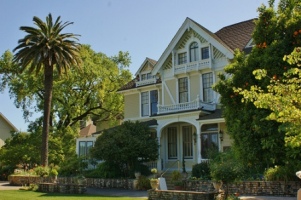
 Mature specimen. Picture courtesy Karl Gercens. Visit his flickr photostreamDescription, History & Interesting Facts:
Phoenix canariensis is a species in the palm family Arecaceae and is endemic to the Canary Islands (meaning it grows wild nowhere else in the world); it is a relative of Phoenix dactylifera, the true date palm. Massive and imposing, the Canary Island date palm is the centre of attention wherever it is planted, with its tall stout trunk 14 to 20m tall and covered with interesting diamond designs that mark the point of attachment of the leaves. Trimmed well, the trunk takes on the appearance of a pineapple, and this palm is also known as the Pineapple Palm in some places. The solitary trunk supports a broad crown with a spread of 8m to 10m, and containing as many as 120, deep green feathery leaves, 4 to 6m long.
Mature palms will produce bunches of cream, bowl-shaped flowers in summer, followed by decorative drooping bunches of orange dates which are edible but not very tasty.
The Canary Island date palm is very widely planted in warm temperate regions of the world, particularly in areas with Mediterranean climates. They are widely planted on the French Riviera, giving a distinctive look to the Mediterranean resorts. They are also planted all along the Gulf of Mexico coastline and throughout Florida; as well as the warm areas of the western U.S. including Arizona, California and Las Vegas, Nevada. It also thrives in Ireland, southern England, Australia, New Zealand and South Africa.
Uses:
In the Canary Islands, the sap of this date palm is used to make palm syrup and the different parts of the palm are used in a number of ways.
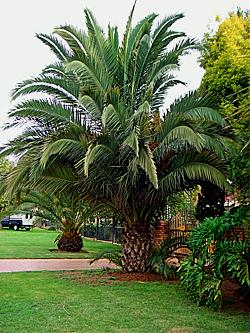 Phoenix canariensis. Young Specimen.In the Garden:
The huge bulk of the Canary Island date palm will dwarf most houses, unless you have a Mediterranean or Victorian style mansion. They are most effective if planted along boulevards and in parks, on campuses and office parks and parking lots.
Planted in groups they make a dramatic statement; especially when under-lit at night. Small specimens make great container plants, looking particularly nice in large terracotta pots placed on the patio, near the pool, or in pairs flanking entryways.
In areas of high rainfall these palms are often seen with ferns growing from among the old leaf stems. Decomposing leaf litter and other fibrous matter collect there, creating absorbent compost that ferns love; forming a hanging garden just below the palm's canopy. The fairy primrose (Primula malacoides), Busy Lizzies (Impatiens) and other small shade loving annuals can also be planted in this.
The Canary Island palm will burn in a fire but can survive, and often grows even stronger after having been blackened by fire. In October of 2013, after more than 1,200 Canary Island Date Palms were damaged by a devastating fire on La Gomera Island in the Canary Islands, a cleanup was carried out which involved climbing up the sooty trunks to reach the sad-looking crowns and remove the dead fronds with saws and special knives. This is dangerous work because of the great height these palms can attain, and also because of the hard needle-sharp spikes at the ends of the fronds. The clean-up was part of fire prevention measures all over the island of La Gomera, and included the removal of thousands of tons of dead and partially burnt vegetation, as well as andy other material that could easily catch alight.
Cultivation/Propagation:
The Canary Island palm is very slow growing when young, but once the trunk reaches its full diameter the growth rate increases. It thrives in the warm, moist, frost-free regions of South Africa, but will grow in most other parts of the country provided it can be watered regularly until established. Adult specimens do not like drought, but have extremely deep roots searching out any ground water, so established palms can go without rain for long periods. These palms can also tolerate swampy ground, as do many Phoenix palms; if not in cold conditions.
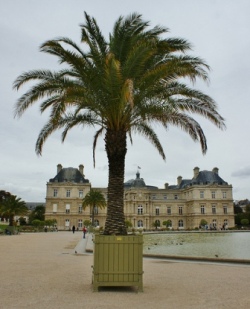 Growing in a Pot. Picture courtesy Karl Gercens Visit his flickr photostreamThe Canary Island palm is wind tolerant and grows well in coastal regions; but young plants are susceptible to leaf spot and other fungal infections when grown in humid climates.
It is hardy to moderate frost, surviving temperatures as low as -2°C without damage, and has been reported to survive temperatures as low as -8° C for short periods once established; but does not like prolonged low temperatures, or several day freezes.
The Canary Island date palm thrives in full sun but will tolerate some light shade. It is tolerant of most well drained soils; for container grown plants use a light, well-drained potting soil and fertilise in spring and summer. It is not uncommon to see Canary Island date palms pruned and trimmed to enhance their appearance; but whilst flowering and fruiting they can be messy.
Propagation is exclusively from ripe seeds sown in spring or summer; cleaned and dried seeds can be successfully stored.
Caution:
In some Mediterranean and subtropical countries, P. canariensis has proven to be an invasive plant. In New Zealand, it has invaded a range of habitats. New Zealand's Landcare Research has classified the palm as a 'sleeper weed' - "a plant that spreads slowly and goes unnoticed until it becomes widespread". In Auckland, New Zealand, the palm has itself become a host for the naturalised Australian strangler fig, Ficus macrophylla.
Warning:
Beware of the sharp spines on the lower leaflets which can be harmful to humans and animals; embedding themselves under the skin and eventually causing infection. Some individuals are also known to be allergic to the plant.