


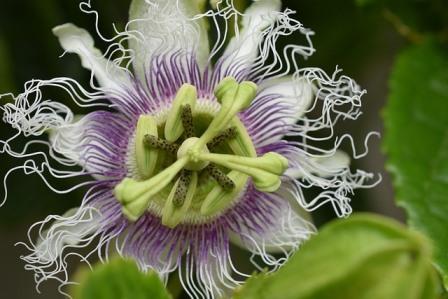
Granadillas are easy to grow in the ground or in pots and their glossy leaves and exotic flowers provide invaluable tropical flair to gardens.
Description History & Interesting Facts:
Passiflora edulis is native to the subtropical and tropical regions of South America, specifically southern Brazil, Paraguay, and northern Argentina. It was introduced to other parts of the world by Portuguese and Spanish explorers and is now grown commercially in similar climates world-wide.
The fruit has been enjoyed by both humans and animals alike for thousands of years but was first documented in 1553 by Cieza de Leon, a civil servant in Colombia. He called the fruit "granadilla" (small pomegranates), and it is believed that the species he documented was potentially the Sweet Granadilla (Passiflora ligularis). Click here to see Google Images of this flamboyant vine.
In 1569, Nicolas Monardes, a physician in Spain, associated the passionflower morphology with the crucifixion of Christ, resulting in the flower being referred to by 16th century Spanish missionaries in Brazil as the “Flor de las cinco lagas” (Flower of the five wounds) and used to illustrate the passion and crucifixion of Christ to the native people.
The symbolism endured and in 1737 Carl Linnaeus established the scientific name of the genus as Passiflora, which means passionflower in Latin. This genus contains an impressive 550 species, each bearing the unique flowers it is known for.
Passiflora is classified as a “pepo” - a type of botanical berry, as are melons, pumpkins, and squash. Pepos are characterized by a hard rind, fleshy interior, and many seeds. Passiflora fits the bill with its round to oval fruits with their hard exterior and soft, juicy interior filled with numerous seeds.
Granadillas have an average lifespan of 3 years, but they can live longer if properly tended to. Watch your older plant, and if it seems to decline or the fruiting decrease drastically, it probably needs to be replaced by a new one.
Giant Granadilla (Passiflora quadrangularis)
The Giant Granadilla is native to the tropical regions of South America. It is loved for its large, showy flowers and the greenish yellow fruits are the largest in the Passiflora genus. The 20 to 30cm oblong fruits are yellow-green with yellow to pink flesh, yellow seeds and a mild flavour.
Ripe fruits are eaten raw or made into drinks, and the immature green fruits are used as a vegetable in similar ways to how green papaya may be used, and the roots of old plants are baked or roasted.
Medicinally, the root and leaves are used as a soothing poultice for the treatment of liver problems. The fruit is used in the treatment of headaches, asthma, diarrhoea, dysentery, neurasthenia, and insomnia.
Giant granadilla plants are now available in South Africa, but please grow them responsibly in urban areas only, as, like the purple granadilla it could easily become invasive.
Purple Granadilla (Passiflora edulis)
The purple granadilla is a fast growing evergreen to semi-evergreen climbing vine with lovely glossy 3-lobed leaves and coiled tendrils which help it cling to supports. Depending on climate, the vine can grow anything from 3 to 15m in length, with an equal spread, though in home gardens it can be pruned to keep it smaller.
The white and purple flowers with their fringe-like corona of filaments that are white with a deep purple base, are as exotic looking as their name suggests, making the passionflower a favourite garden subject.
The oval fruit measures 5 to 8cm, has a tough purple skin, orange flesh and black seeds. The purple granadilla is acidic but sweet, with a rich flavour and lots of juice, making it perfect for eating fresh.
Granadilla ‘Ester’
In South Africa the purple granadilla type, specifically the variety ‘Ester’ is the most commonly grown variety for commercial use and home gardens. Ester is a cross between the yellow (Passiflora edulis f flavicarpa) and the purple granadilla (Passiflora edulis f edulis).
Click here to shop Granadillas in season at our online shop
 Giant Granadilla Image by Maya A.P from PixabayPollination
Gardeners often ask why their granadillas don’t produce fruit, and the answer is simply a lack of pollinators in your garden and the type of granadilla you are growing.
Self-compatible granadilla vines produce fruit from their own pollen, requiring no other compatible tree. This is possible due to the flower morphology being structured so that the anthers are placed below the stigmas.
Self-incompatible fruits require pollen from a different yet compatible cultivar to set fruit.
Additionally, depending on the variety, the plants can be either self-compatible or self-incompatible.
Although Passiflora edulis is listed as being mostly self-incompatible, South African farmers and gardeners alike rely on honey bees and carpenter bees for pollination. Honey bees visit the flowers for both nectar and pollen, and the carpenter bee is the most efficient pollinator due to its foraging behaviour and larger size.
To assure the presence of carpenter bees, it is wise to have decaying logs on the ground among the vines to provide nesting places. Attracting bees is easy if you provide them with food sources in the garden.
The pollen of passion fruit flowers is heavy and sticky, making wind pollination ineffective. Hand pollination may be necessary if there are not sufficient natural pollinators in your area.
In addition, the amount of pollen deposited on the stigma during pollination determines the number of seeds set and size of the fruit. A passionfruit can develop hundreds of seeds and if too few of the ovules develop into seeds the fruit is likely to be hollow and light in weight with little juice.
Health benefits of granadillas
Granadillas are a source of proteins, minerals, vitamins, carbohydrates and fat.
They are loaded with vitamin C, a great antioxidant our body uses it to make blood vessels, cartilage, muscles, and collagen which keeps your skin looking young. It also helps your body heal, lowers inflammation, and protects your cells from damage. They are also a good source of vitamin A, essential for healthy eyes.
When eaten whole, the seeds have a fibre content of approximately 1.9 grams, making the fruit good for gut health and preventing constipation. The seeds also are a good source of protein, minerals, and heart-healthy fats. Some research suggests compounds in the seeds may also help relax and widen blood vessels, adding to their cardiovascular benefits.
Passion fruit also gives your body calcium, magnesium, phosphorus, potassium, and folate. These help boost the health of your kidneys, nerves, muscles, and heart.
Eating granadilla regularly helps the body produce red blood cells, white blood cells and platelets. Thanks to the iron, potassium, phosphorus and vitamin B the fruit contains, the production of these blood cells increases, helping to prevent conditions such as anaemia.
 Passionfruit Tart Picture courtesy PixabayIn the Kitchen
If you’re a fan of both sweet and sour flavours you’re sure to love granadillas, so transport yourself to the tropics with tangy passionfruit - there are so many possibilities when it comes to this fruit.
It adds a tangy twist to both sweet and savoury dishes, so mix up a fruity passionfruit cocktail - try a Maracuya Sour or Passionfruit Mojito. Indulge in a summery passionfruit parfait, or a dark chocolate and passionfruit ganache. Mix it into vanilla buttercream frosting for icing cakes and cupcakes. Add it liberally to tarts, and for special occasions make a passionfruit Pavlova.
Make passionfruit jam with 1 cup pulp, 1 cup sugar, 1 tsp pectin, and 1/4 tsp vanilla. Enjoy it on toast, mixed into yogurt, or as a cake filling.
Try pairing passionfruit sauce with fish, duck, turkey or chicken, or turn it into a salad dressing, using the pulp and the seeds which add a lovely crunch, combined with vinaigrette made with lime juice and extra virgin olive oil, sugar, salt and black pepper.
Cultivation:
Click here to shop Granadillas in season at our online shop
What climate is best for growing granadillas?
Granadillas are native to warm tropical and subtropical regions and thrive in relatively high humidity, and where rainfall is good, at least 1 200mm per year.
They do best in moderate temperatures with a minimum of 5°C and a maximum of around 30°C.
Is granadilla frost hardy?
Granadillas are sensitive to cold and frost, and cold soil temperatures may cause inter-vein yellowing of the leaves. In moderately cold climates they can be planted outdoors in a warm spot where they are sheltered from cold winds. A sunny wall or warm patio would provide protection.
In cold regions, you will need to plant into containers that can be brought indoors, or moved to a more sheltered outdoor location near a north-facing wall or under a covered patio for winter protection. A covering of frost protection cloth works wonders in protecting sensitive plants, and wrapping the pots with bubble wrap will help keep the soil warm in winter.
During cold winters granadillas could go dormant, but if they are protected should, bounce back and shoot again in spring.
How much sun do granadillas require?
Granadillas need lots of sun to grow strongly and produce the best fruits. They will still thrive in lightly shaded areas. In hot and drier climates, they will benefit from light afternoon shade to prevent scorching, or full morning sun.
How much water do granadillas require?
Granadillas like to be kept moist, but absolutely hate being waterlogged, so good drainage is vital. Thorough and deep watering is particularly essential while the fruits are maturing. If the soil is allowed to dry out during this stage, the fruit might shrivel up or fall from the plant.
Regular watering will keep a granadilla vine flowering and fruiting almost continuously – up to three harvests a year. Irrigation - up to 15 litres per plant per day can supplement low rainfall.
Planting granadillas
In warm regions granadilla plants can be planted at any time, but in cold regions early spring, once all danger of cold weather is over is best. Prepare the soil in advance by digging a hole of 1m x 1m and enriching the soil as detailed below.
When planting your vine, plant it no deeper than it was in the bag or pot you bought it in, and plant trellises at the same time to avoid damaging the roots later.
If you’re planting more than one vine, space the planting holes 1.5m apart.
What soil is best for granadillas?
Granadillas prefer a slightly acidic to neutral pH, ideally between 5.5 and 7.0, though some sources recommend a narrower range of 6.5 to 7.5 for optimal fruit production.
As granadillas have deep root systems, the soil should be rich in organic matter to ensure it is loose and well-draining. Avoid compacted or clay soils that have not been amended. Improve poor or sandy soil with lots of compost and mix some bonemeal, superphosphate or organic 2:3:2 into the soil at the bottom of the planting hole to encourage good growth.
Alternatively, consider adding Superfrass and Volcanic Rock Dust to your composted soil for fantastic results.
Superfrass is a natural high quality organic growth enhancer and pesticide. It is packed with macro-elements (N, P, K) and micro-nutrients (Zn, Cu, etc.), which enable your plants to grow robustly. It also contains Chitin, a natural molecule that helps plants to defend themselves against insects, disease pathogens and predators, such as root feeding nematodes.
Volcanic Rock Dust contains more than 72 minerals and trace elements that nourish the soil returning it to a healthy, rich state. Obviously, healthy soil will produce healthy plants. It is very easy to use and will never ‘burn’ a flower or plant, and a little will go a long way!
Click here to shop for our Superfrass and Volcanic Rock Dust
Fertilising granadillas
Granadillas are fast, vigorous growers and need a lot of nutrients.
At the beginning of the growing season, in July/August, feed the plants with a balanced organic fertiliser like 2:3:2.
In December apply an organic fruit fertiliser like 3:1:5, and repeat again in April.
If you notice any deficiencies in your plants, apply any liquid fertiliser containing micro-nutrients. This can be done once a month during the active growing season to prevent deficiencies.
Growing granadillas in pots
Granadillas thrive in large, sturdy pots which can support a trellis. This also helps keep the vines contained and great for smaller gardens with little space for outdoor planting.
Plant in rich well drained soil and treat as for vines growing in the ground. However, you will have to check for watering more often and potted vines will also need regular feeding. Liquid or slow release fertilisers are ideal for potted plants and convenient to use.
Click here to find out slow-release fertiliser
Staking granadilla vines
Granadilla vines are very strong and vigorous growers and require a sturdy support in the form of a trellis, fence, wall, arch or gazebo to grow up against. This also allows for easy pruning and harvesting.
Granadillas can also be trained to grow along a wall (espalier) which is very practical and space saving for urban gardens.
Initially you might have to tie the main stem to the support with a soft tie, but the little tendrils on the shoots will quickly start attaching themselves.
Don’t let them grow against or up other plants or trees as they will very quickly get out of hand and take over.
Click here to see our range of trellises and supports
Companion planting to encourage pollinators
Planting a variety of flowers and flowering herbs near your granadilla will attract pollinating insects– this is vital for quality fruit formation.
Pruning granadillas
Granadillas only set fruit on new growth so pruning is essential. Pruning is best done before the spring flush of growth. Remove all tangled branches and deadwood. Then cut all the healthy shoots back by about one third to promote new, strong growth and abundant fruit.
Harvesting & Storing Granadillas
It may take around two seasons of growth before your plant starts producing fruit, after which two main crops can be harvested per year in South Africa. A summer crop is harvested from November to January, and another smaller crop can be picked in winter (June to July). Some granadilla producers in the Northern and Mpumalanga provinces may have a third small harvest in March/April. Purple granadillas ripen earlier than the yellow type.
Granadillas are climacteric fruit i.e. they will continue to ripen after harvesting. Ripe granadillas become sweeter after harvesting, but green granadillas will not ripen fully off the vine. Ripen at room temperature or store in a refrigerator when fully ripe.
Purple passionfruits are picked for the fresh fruit market when the skins are light purple. When used for processing such as juicing, the fruit is picked when skins are dark purple. Commercial growers may apply a wax to the skins to prevent shrivelling and drying.
Gardeners generally pick the fruits when they are fully developed and dark purple in colour, and the fruit falls from the plant if you shake it gently. Fruits wrinkle as they mature and this is when they are at their best! Harvest early in the morning before the heat of the day.
Propagation
Granadillas can be grown from cuttings or seed. To grow from seed, allow fruit pulp (with seeds) to ferment for a few days in a plastic container. Wash to separate seeds from the pulp and sow in well-drained soils.
 Granadilla Image by andreas N from PixabayIs Passiflora edulis invasive in South Africa?
Passiflora edulis has naturalised and become invasive in many countries, including New Zealand and South Africa.
Passiflora edulis is one of 14 species of Passiflora introduced to Southern Africa, eight of which became naturalized, and four which were declared Category 1 invasive plants. Category 1 invasive plants are restricted or prohibited and must be removed and destroyed, as they have high invasive potential, smothering indigenous trees and shrubs.
While not as serious an invader as some other species, Passiflora edulis is nevertheless listed as a Category 2 invasive in parts of South Africa.
Category 2 invasive species are regulated by area. A demarcation permit is required to import, possess, grow, breed, move, sell, buy, or accept as a gift any plants listed as Category 2 plants.
Special exemptions are given for commercial growers. No permits will be issued for Category 2 plants to exist in riparian zones – the transitional areas where terrestrial land meets water bodies like rivers, lakes, and streams.
Legislation is often confusing and is continually changing, but currently Passiflora edulis is classified as a Category 2 invasive in the Eastern Cape, Gauteng, KwaZulu-Natal, Mpumalanga, Limpopo and North-West.
However, cultivation may not be restricted in urban areas of the above listed provinces, so check before purchasing plants.
Passiflora edulis is not listed as invasive elsewhere in South Africa.
Problems, Pests & Diseases of Granadillas
Granadillas may show signs of zinc and boron deficiency
Zinc deficiency in granadillas can be managed by using foliar sprays containing zinc, especially in spring, and ensuring the soil has proper drainage and nutrient balance. Symptoms include small, distorted leaves and yellowing between the leaf veins, often appearing on the youngest shoots.
Boron deficiency in granadillas can cause misshapen, bumpy, and malformed fruit, along with stunted growth and poor fruit set. Other symptoms include deformed young leaves and, in severe cases, a risk of the growing point dying. Climatic conditions where there is a severe reduction in water supply (droughts) are typically the initial condition for the occurrence of this deficiency.
Both Boron and Zinc deficiencies can be treated using Trelmix, a trace element solution used to correct deficiencies and promote overall plant health by supplying essential micronutrients, vitamins, and minerals. It enhances root and foliage development, boosts resistance to disease, and helps correct issues like yellowing leaves (chlorosis). Trelmix is applied as a soil drench or foliar spray and can be used alongside regular fertilisers.
The main pests and diseases of granadillas are Fusarium wilt, nematodes and crown rot. Nematode damage is visible as stem lesions near the soil line. Footrot is caused by waterlogged soil.
The yellow granadilla is more resistant to wilt and nematodes and is used as a rootstock for the purple variety.
Both variants are susceptible to Phytophthora cinnamoni.
Snails attack granadilla leaves and thrips can be a problem on seedlings.
Caution:
Passion fruit poisoning
The pulp contains a substance called cyanogenic glycoside -- a common natural toxin also found in cassava, apple seeds, apricot pits, almonds, and other plant foods. This chemical can cause cyanide poisoning in very high amounts. It’s highest in very young, unripe passion fruits. Once the fruit is ripe, it’s safe to eat.
Passion fruit allergy
Some people are allergic to the fruit. This is more likely if you’re allergic to latex.