


Cape Bugle Lily, Pink Watsonia, Suurkanol, Kanolpypie - Watsonia
Condensed Version: Watsonia borbonica 'Pink'
Many watsonia species are losing habitat throughout their range due to crop cultivation; making it important for us to continue cultivating them in our gardens.
Because they are so easy to grow and have a long flowering period, watsonias are ideal for busy gardeners. They are also perfect water-wise plants for the winter rainfall regions; thriving in a Mediterranean climate.
They are suitable for all gardens and look magnificent in mass plantings; or planted in clumps in herbaceous borders; or even in large containers.
They are also excellent for soil retention on banks.
All species are perennial herbs growing from corms and producing attractive upright lance shaped leaves and erect spikes of showy flowers during spring and early summer (September to around January in South Africa).
Prior to this, it endures a growth stage and, after flowering, will die back for the hottest time of the year (February and March).
Watsonias are easy to grow in full sun or light shade; and although most are adapted to a winter rainfall climate, they will still thrive under summer rainfall conditions provided they are grown in well-drained soil and can be watered during their growing season.
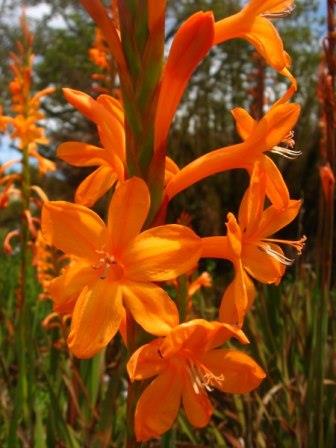 Watsonia pillansiiFull Version:
Description, History & Interesting Facts:
Watsonia is a genus of plants in the Iris family and endemic to South Africa; meaning originally they could not be found growing wild anywhere else in the world. Having said this, watsonia species were introduced as garden ornamentals to Australia in the mid-19th century and were widely grown by the 1940s. Today, in the South-West of Western Australia, six species have escaped from garden cultivation and become naturalised along rivers, wetlands and seasonally wet ground. In places Watsonias have displaced native understorey flora and high concentrations of them create a fire hazard in summer. Watsonia meriana var. bulbillifera is also a weed in New Zealand, Réunion and Mauritius; and Watsonia borbonica has naturalised itself in the USA.
There are about 52 Watsonia species; most of which are concentrated in the south-western parts of the Western Cape, but also extending north into Namaqualand and east into the summer rainfall areas of southern KwaZulu-Natal, Lesotho, Mpumalanga and Swaziland. Most are deciduous fynbos plants which are adapted to a Mediterranean-type climate with hot, dry summers and wet winters; and the majority of the species occur in mountainous regions, with a couple occurring in sandy flats and marshy areas.
 Watsonia fourcadeiThose which occur in the summer rainfall regions are evergreen. Evergreen selections include; Watsonia angusta, Watsonia fourcadeii, Watsonia galpinii, Watsonia knysnana, Watsonia pillansii and Watsonia zeyheri. Deciduous selections include; Watsonia borbonica, Watsonia marginata, Watsonia meriana and Watsonia vanderspuyiae
Watsonias will burst into bloom during the spring and early summer months (September to around January in South Africa). Prior to this, it endures a growth stage and, after flowering, will die back for the hottest time of the year (February and March). The flowers last for four or five weeks, making this a rewarding addition to the garden.
All are perennial herbs growing from corms 30 to 40mm in diameter with grey-brown tunics; producing attractive upright lance shaped leaves and erect spikes of showy flowers. In the wild the plants flower particularly profusely in the first and second years following a fire; and in recently burnt areas provide a major source of food for nectar-feeding birds, insects and rodents.
The most commonly cultivated species is the pink-flowered Watsonia borbonica and its white mutant Watsonia 'Arderne's White'.
(Watsonia borbonica)
Watsonia borbonica grows in the extreme southwest of the Western Cape, from Tulbagh southwards to the Cape Peninsula and eastwards to Bredasdorp. It is commonly found growing on rocky sandstone slopes or well-drained slopes of clay and granite, and sometimes in deep sandy soil at the foot of the mountains.
This stately plant produces upright, broad and glossy, sword-shaped leaves, and 2m tall spikes of rose-pink, trumpet-shaped flowers.
 Watsonia meriana(Watsonia aletroides) Rooipypie
The Rooipypie ranges from the Bot Rivier to Knysna and Uniondale and is widely distributed; occurring on clay soils throughout the Overberg, the Riversdale Plain, the Little Karoo and Upper Breede River Valley. It is still found on renosterveld fragments in the Overberg.
This beautiful watsonia has pendulous blooms in shades of pink, orange or red, and only reaches +-55cm tall, making it excellent for smaller gardens and pot cultivation.
(Watsonia marginata)
Marginata is also a Cape species and has flowers which are different from other watsonias in that they are cup-shaped rather than trumpet-shaped, and are held on unusually long spikes +-1.2 to 2 meters tall, with up to 50 densely packed flowers.
Flowers can be mauve, pink, white or maroon. The leaves are also most attractive, being broad, bluish-green in colour, with conspicuous yellowish margins.
(Watsonia fourcadei)
Watsonia fourcadei is found in the Eastern and Western Cape and has pretty salmon pink flowers. It grows +- 90 to 180cm tall.
 Watsonia borbonica ssp ardernei 'White'(Watsonia pillansii)
Watsonia pillansii can be found growing wild in the Eastern and Western Cape, and KwaZulu-Natal and is an extremely handsome watsonia with broad, grey strap shaped leaves and bright orange flowers. It grows +-50 to 120cm tall; multiplies rapidly; and prefers moist conditions.
(Watsonia meriana)
Watsonia meriana has many garden hybrids in cream, pink and red, and puts on a spectacular show. It grows +- 60cm to 1m tall, making it great for smaller gardens and pot culture.
In the Garden:
Many Watsonia species are losing habitat throughout their range due to crop cultivation; making it important for us to continue cultivating them in our gardens. Because they are so easy to grow and have a long flowering period, watsonias are ideal for busy gardeners.
They are also perfect water-wise plants for the winter rainfall regions; thriving in a Mediterranean climate. They are suitable for all gardens and look magnificent in mass plantings; or planted in clumps in herbaceous borders; or even in large containers. They are also excellent for soil retention on banks. When not in bloom, the foliage is still decorative and after flowering has finished, attractive seed pods are produced.
Watsonias are great subjects for low maintenance gardens and their flowers will attract sunbirds. The blooms last quite well in a vase, so feel free to cut the stems for bouquets as this will not hurt the plants.
 Watsonia mixed Picture courtesy HadecoCultivation:
Watsonia are easy to grow in full sun or light shade; and although most are adapted to a winter rainfall climate, they will still thrive under summer rainfall conditions provided they are grown in well-drained soil and can be watered during their growing season. If drainage is a problem, cultivate them in raised beds or containers.
They do not require rich soil, but adding compost to the beds when planting; and mulching around the roots occasionally will give them a boost. They also do not need copious amounts of fertilisers; and an occasional feeding during the growing season (autumn, winter and spring) with small doses of a balanced organic fertiliser will be sufficient.
Actively growing and blooming plants will look at their best if watered moderately during long dry spells. If the plants are happy in their position they will multiply freely, making them perfect for busy gardeners.
In South Africa corms become available in March and April and are planted out in March, April or May. Plant the corms at a depth of approximately half their diameter (+-4 to 6cm deep) and about 10 to 15cm apart. The corms look like fat, flat gladiola bulbs and there is a small point or even a bit of last year's stem on the side that should be placed facing up. Water well after planting; and moderately thereafter until established.
 Watsonia borbonicaAt the end of the growing season the leaves will turn yellow and die back as the plant slips into dormancy. Don't cut off the dying leaves until they turn completely brown, because they will gather sunlight to create food through photosynthesis; strengthening the bulb for the future.
The plants will remain dormant until the next growing season and in areas with excellent drainage they can be left in the soil, but if you live in a very cold region, or irrigate your garden all year round, it may be better to lift and store the corms when they have finished blooming.
The clumps will continue to flower regularly as long as they do not become overcrowded. Lifting and dividing the plants every three to five years will keep them blooming well.
Pot Cultivation:
If you wish to grow them in containers, choose large heavy ones because watsonias can grow quite tall. Plant the corms a bit closer together than you would in garden beds for a glorious show.
Fill your containers with good quality, well-drained soil. Almost any commercially available potting medium should work fine; but if you're worried about drainage, add some washed river sand to the mixture. Make sure there are adequate drainage holes because watsonias must never sit in waterlogged soil or they will rot. Also, do not allow the pots to stand in drip trays full of water for long.
In the winter rainfall region the winter rains usually begin in April and potted plants should be watered sparingly at this time. In the summer rainfall regions you will need to water regularly during the growing season. During the dormant period, stop watering pot-grown specimens and if necessary, move them to a cool, dry place.
Site your containers where they will receive full sun and water regularly during dry periods. Watsonia will form sizeable clumps over time and eventually flowering will diminish. When this occurs, dig up the clump and separate it into a number of smaller plants.
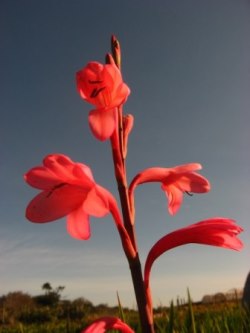 Watsonia borbonica 'Dark Pink'Propagation:
Watsonia borbonica produces offsets abundantly, and the easiest method of propagation is by division. Clumps can be lifted and divided at any time during the dormant season and re-planted in autumn. After lifting, store the corms in a cool, dry place or re-plant immediately to avoid mealy bug infestation.
Seed is sown from April to June into deep seedling trays. Sow thinly into a well-drained medium like, 2 parts sand, 2 parts compost, and 1 part loam. Seeds should be planted 3 to 4mm deep, covered with clean sand and kept moist and lightly shaded. Protect them from rain during this period. Seed germinates readily within 3 to 4 weeks. Reduce watering towards the end of the growing season and withhold completely when they young plants are dormant; resuming again in the autumn. Plants grown from seed should start flowering in their second or third year.
Problems, Pests & Diseases:
Watsonias are generally hardy plants with few pests and diseases attacking them; but watch out for snails and slugs who occasionally eat the leaves , and thrips which can damage the flowers.
January
 Agapanthus 'Blue Velvet'What to do in your garden in January
All Regions
January marks mid-summer in the garden and the weather can be very unpredictable; it can be terribly hot and dry; or extremely wet. There is a lot to be done in the garden this month; in regions that have received heavy rains it is essential to feed regularly, as heavy rains leach food out of the soil. In very hot and dry regions do not overfeed, especially with high nitrogen feeders, as this will encourage lush, soft growth that is easily scorched. In hot regions try to do your gardening chores in the early morning or in the late afternoon.
Do not transplant shrubs this month and plant seedlings in the cool of the evening. To keep your bedding plants flowering into autumn, continue to feed them and cut out the dead flowers regularly; it is also time to start sowing many winter flowering annuals and vegetables.
Before planting that cute little Christmas tree you bought into the garden, please find out how big it grows first. Most varieties are very large growing and will eventually dwarf small gardens, producing dense shade and allowing nothing to grow underneath them. Rather consider re-potting your tree into a larger container and growing it on for next year. Place the pot in a semi-shaded position for a few weeks, so that it can acclimatise to the outdoors, before moving it into direct sun.
Roses
Preventative spraying of roses is the best control method for pests and diseases; during wet weather the plants are susceptible to black spot, and in hot dry weather they can be plagued by red spiders, so keep a look out for these. Continue to fertilise regularly and prune lightly if necessary to remove any weak or spindly growth; but remember that roses need plenty of healthy leaves to protect them from the fierce summer sun.
 Fuchsia 'Blue Eyes'. Picture courtesy Ball Horticultural CompanyAzaleas, Camellias, Hydrangeas & Fuchsias
Water loving plants like azaleas, camellias, hydrangeas and fuchsias need plenty of water during hot, dry spells and will benefit from having their leaves sprayed down regularly with water.
Your camellias will be forming their winter and spring buds now, so water them regularly but don’t over fertilise them now as this may cause them to abort their flower buds in favour of new leaf growth.
Remove any seeds from your fuchsia plants and pinch back the growing tips that are not flowering, this will encourage the formation of secondary buds along the stems; feed with organic 3:1:5.
Remove faded flowers from your hydrangeas unless you want to keep them for autumn colour. Cut them back to the first pair of healthy, plump looking buds; and tidy them up by cutting old woody stems out completely at the base of the plant. This will encourage new basal growth.
Members can click on highlighted plants for more info.
Lawn
Do not cut your lawn too short, keep it at a height of 5cm, and remove any grass cuttings immediately. Fertilise regularly with a balanced, organic fertiliser. A fertiliser high in potassium like 3:1:5 or 5:1:5 will encourage strong, deep roots that are more heat tolerant.
Mulch
If necessary, mulch your beds with a layer of compost or bark chips, to conserve moisture. Do not mulch with wood shavings, as this will attract white ants. Coarse bark mulch, bought from a reputable supplier contains a type of tannin, which repels white ants. Click here to read my article on mulching.
 Chrysanthemum OrangePerennials and bulbous plants
Perennials and bulbous plants are wonderful additions to the garden, adding seasonal colour and contrast throughout the year. If carefully worked into the landscape and cared for correctly they never fail to perform and are a delight to have. Click here to find plant lists and articles on perennials.
Perennials
Do not split and divide perennials in summer when they are actively growing; rather do this in autumn, or in spring and early summer.
Cut back perennials like Shasta daisies, lavender and daisy bushes when they have finished blooming in order to promote a second flush of flowers before winter.
If you are planting potted chrysanthemums into the garden, first pinch out the growing tips to encourage bushy growth.
Tug out the flowering stems of Inca lilies (Alstroemaria) as they finish flowering and remove the spent flower spikes from your agapanthus. If your wild rhubarb (Acanthus) is untidy cut it right back to ground level, mulch it with compost and water well.
Bulbs
 Lilium Oriental Hybrid Picture courtesy F. D. Richards from flickrPlant out bulbs of Amaryllis belladonna (March lily) as soon as they are available; and they should provide a romantic display of scented pink and white trumpet flowers in time for Valentine’s Day – remember to keep the necks of the bulbs above ground level.
Finish planting Nerine bulbs, and collect any ‘plantlets’ on the older stems of your day lilies to propagate.
Feed your Liliums and cut off the spent flower heads regularly, but when cutting leave as many leaves on the plant as possible, as these will produce food for next seasons flowers.
Sow Anemone and Ranunculus seed before the end of January, so that they will be ready for the winter and spring garden.
Cut back the spent flowering stems of Cannas to encourage continuous flower production, and water regularly.
Lift and divide overcrowded white and green Arum Lilies that are starting to die down. Cut off all the old leaves and replant only healthy plants, adding lots of compost and a generous sprinkling of bone meal.
 Lily BorerPests & Diseases
Lily borer caterpillars
Check for lily borer caterpillars, they attack the bulbs and leaves of many plants like amaryllis, agapanthus, crinum, nerine, clivia, and crytanthus (George lily). Spray regularly with Margaret Roberts Biological Caterpillar insecticide.
Red spiders
Red spiders are especially troublesome during hot, dry spells and affect many plants, including fuchsias, hydrangeas, roses, and beans.
Fungal diseases
During hot, humid days, or following heavy rainfall, fungal diseases like, powdery and downy mildew, rust and black spot are especially prevalent. Barberton daisies, roses, dahlias, daisy bushes, geraniums, hydrangeas and vegetables like pumpkin & squash, eggplant and tomatoes are very susceptible.
Take Semi-hardwood cuttings
Take semi-hardwood cuttings of evergreen plants like buddleia, hibiscus, camellia, fuchsias, azaleas, daisy bushes, lavender cotton (Santolina), lavender and perennial vygies.
 Cymbidium OrchidPrune
Prune wisteria climbers that are growing rampant but do not remove the new flower buds that are forming near the base of the new branches. These will bloom next season. Lightly prune your bottle brushes when they have finished flowering. Remove all the soft, red-brown water shoots from the base of your bougainvilleas as soon as they appear.
Aquatic plants
Remove the decaying leaves from your aquatic plants in ponds, as they can pollute the water.
Cymbidium orchids
Start feeding your Cymbidium orchids with a feeder that is low in nitrogen but high in potash like 3:1:6 to encourage the formation of flower spikes. Water and mist spray regularly in very dry regions.
Indoor pot plants
Mist spray your indoor pot plants regularly with water, this will keep them clean and healthy, especially in air-conditioned homes and offices where the air tends to be dry. Occasionally, place them outside in a shady spot and hose the leaves down gently with water, or even better, put them outside when it is raining gently.
Members can click on highlighted plants for more info.
 New Potatoes Vegetables
Your vegetable garden should be flourishing, so harvest regularly to ensure that your plants keep producing. Carrots should be pulled before their shoulders go green, green beans before they become ‘stringy’, and baby marrows before they become too large. Lift and divide your shallots, replanting only healthy bulblets; and as your onions mature, reduce the amount of water they receive. When your onions are ready to harvest, lift them with a fork and shake off excess soil before laying them out to dry in a cool, well-ventilated place.
Once your potatoes have finished flowering, reduce watering, and when the leaves go yellow you can test to see if they are ready to lift. To store, brush off the excess dirt and ensure that the potatoes are completely dry before storing in a cool dark place – do now wash before storing. Provide support for heavily the laden branches of eggplant and tomatoes.
Feed and water your veggies regularly, especially in hot, dry weather; and if sowing seeds directly into garden beds in the heat of summer, remember that they may require watering twice a day; mulching with straw or dry grass cuttings will help to conserve moisture.
Always check your ‘weeks to maturity’ on the back of your seed packets before sowing vegetable crops at this time of the year, or crops which need a long growing season like eggplant, peppers, tomatoes and pumpkins will start maturing too late to be successful. In regions which experience early frosts, plant out only well-established seedlings of these slow maturing crops.
Continue sowing fast maturing summer vegetables like baby marrow, radish, spring onions and Swiss chard and plant only heat tolerant varieties of lettuce. January is the last month to sow green beans unless you live in subtropical areas.
Loose leaf varieties of lettuce like ‘Vera’, a lovely frilly red variety, and ‘Veneza Roxa’, a frilly green lettuce; and ‘Elise,’ a great butter lettuce are all heat and cold tolerant and grow quickly if grown correctly, making them ideal to sow or plant out now. Individual leaves can be harvested as required when the plants are young and the whole plant can be harvested towards the end of the growth cycle; making them perfect for summer salads.
Lettuce requires fertile, well-drained soil and grows best in semi shade in summer (30% shade is sufficient). Mulch the plants and water regularly, keeping the soil constantly moist; this prevents them from tasting bitter and running to seed. Water occasionally with 1 teaspoon of Epson salts to 1 litre of water for great leaf colour and taste. Keeping the seeds in the refrigerator overnight before sowing will help germination.
In cold winter regions start sowing slow maturing winter vegetables like Brussels sprouts, broccoli, cabbage, cauliflower and kohlrabi now.
 Comfrey FlowersHerbs
Continue to plant perennial herbs like thyme, oregano, marjoram and rosemary. In frosty regions sow a last crop of annual herbs like Basil, borage, coriander, dill, rocket, parsley, sage and mustard.
Take semi hardwood cuttings of herbs like rosemary, thyme, tarragon, oregano, marjoram and sage.
Comfrey has the most beautiful flowers and I cannot bring myself to cut them off until the flowers begin to fade; but cutting comfrey back as it comes into bloom will encourage a new batch of leaves. Add the harvested leaves to your compost heap or use them to make a wonderful liquid fertiliser.
Flowering annuals
January is an awkward time of the year to sow flowering annuals, especially in cold winter regions, as many of them will be at their best just when the cold winter weather hits, so check the ‘weeks to flowering’ on the back of your seed packet before sowing.
Instant colour seedlings from your nursery may be a better choice at this time of the year; try marigolds, vinca, celosia, verbena, alyssum, gazanias and cosmos for sunny areas, and begonias and coleus to brighten up shady areas.
Established petunias and salvia can be cut back, mulched and fertilised to encourage more flowers.
In cold winter regions it is time to start sowing winter and spring flowering seedlings such as pansy, cineraria, foxglove, aquilegia, Iceland poppy, viola, delphinium, larkspur and primulas into seedling trays. Keep them moist and in a cool, shaded area. Store larkspur and delphinium seed in the refrigerator before sowing to improve the germination rate.
Members can click on highlighted plants for more info.
 strawberry barrelRFruit
Berries like loganberries, youngberries, raspberries and blueberries need to be fed and the new canes tied onto supports. Harvest your Cape gooseberries regularly and feed your strawberry plants with a high nitrogen fertiliser, water them regularly and mulch the soil.
Grapes are susceptible to downy mildew, so water early in the morning and spray regularly with an organic fungicide. Feed them this month with a fertiliser that is high in nitrogen. As the grapes mature reduce watering; and for the best flavour only harvest them when they are fully ripe. Protect the ripening bunches from birds with mesh bags or bird netting.
If your citrus trees are bearing too many fruits, thin them out and water deeply and regularly, especially in dry regions.
Prune your deciduous fruit trees like peaches and nectarines in the summer by removing any strong branches that are growing in the centre of the top of the tree and overshadowing the centre; or the fruit bearing shoots on the inside of the tree could die off because of a lack of sunlight, and developing fruit that receives too much shade will have a poor quality. When your trees have finished bearing, feed them with a good general fertiliser like 2:3:2 and remove all fallen or rotten fruit from the ground. Continue to splash fruit fly bait onto the leaves of late bearing varieties every ten days.
Spray quinces against coddling moth.
Feed tropical fruits like bananas, mangoes and paw-paws with a balanced fertiliser. Feed your avocado trees with an organic 3:1:6, this will help prevent the fruit from dropping prematurely. Feed your bananas with 3:1:6 and keep them moist. You can also feed your paw-paws and mangoes with 3:1:6 or 2:3:2.
Summer rainfall (Temperate or Highveld Regions)
January is one of the hottest months of the year and it can be very windy, with lots of thunderstorms. Rain quickly leaches nutrients out of the soil, so fertilise your beds regularly with a balanced, organic fertiliser.
It is too late to sow most summer seedlings but you can still plant instant colour seedlings and fast maturing varieties.
In cold winter regions it is time to start sowing winter and spring flowering seedlings such as pansy, cineraria, foxglove, aquilegia, Iceland poppy, viola, delphinium, larkspur and primulas into seedling trays. Keep them moist and in a cool, shaded area. Store larkspur and delphinium seed in the refrigerator before sowing to improve the germination rate.
In cold Highveld areas start preparing your trenches to plant sweet peas. Choose a sunny spot and dig the trench 250mm deep and wide. Mix generous quantities of mature kraal manure and compost into the soil before putting it back into the trench, and adding one cup of slow release fertiliser per running meter; water and allow the soil to rest until planting time.
In cold winter regions start sowing slow maturing winter vegetables like Brussels sprouts, broccoli, cabbage, cauliflower and kohlrabi now.
.Sow or plant seedlings of Swiss chard, carrots, leeks, turnips, and parsnips, and do a final sowing of green beans.
Winter rainfall regions (Mediterranean)
January is one of the hottest months of the year and when the south-easter is blowing it dries out your soil quickly, so mulch your garden beds if you have not done so yet. Do not over fertilise this month; as this produces lots of soft, lush growth which wilts easily in the heat and wind, and requires more water. Water your shrubs and trees thoroughly and deeply once a week, as early in the morning as possible. You can also water late in the afternoon, as long as the leaves have time to dry out before nightfall. Windless, overcast evenings, combined with wet leaves, will encourage fungal diseases. You will need to water your seedlings and pots more often.
Replace tired bedding plants with heat-tolerant varieties like portulaca, marigolds and vinca. You can still plant seedlings such as alyssum, begonias, cleome, candytuft, cineraria, chrysanthemum, coleus, delphinium, dianthus, gypsophilla, larkspur, lobelia, nicotiana, nasturtium, petunia, pansy, viola, Iceland poppy, phlox and verbena.
Start sowing cool season crops like broccoli, cauliflower, cabbage and Brussels sprouts into seedling trays this month and keep in a cool place. You can still plant or sow beetroot, carrots, parsley, radish, spring onions, Swiss chard, leeks, turnips, and heat tolerant lettuce. Make a final sowing of green beans, baby marrow, and patty pans.
Subtropical summer rainfall regions
January is one of the hottest months of the year, with lots of rain and high humidity; so don’t water in the evening, as this will promote fungal diseases; the best time to water is very early in the morning. Spray plants that are susceptible to fungal diseases regularly with an organic insecticide such as Ludwig Copper Count, or Biogrow Copper Soap.
If you have yellow spots on your lawn, it could be a fungal disease, consult with your local nursery and spray with an organic fungicide if necessary.
Rain quickly leaches nutrients out of the soil, so fertilise your entire garden regularly with a balanced organic fertiliser.
Keep a look out for insect infections like aphids and mealy bug - they thrive in hot humid conditions. Ants, white ants, scale and the rhinoceros beetle can also become problematic.
Check your bromeliads for scale and spray them with Oleum if necessary; do this in the cool of the afternoon. Oleum is a mineral oil, which suffocates the scale, but can burn the leaves if sprayed in strong sunlight. Blast stagnant water out of the central vase of bromeliads with a jet of water; as this old stagnant water can breed mosquitoes.
Mist spray your staghorn ferns with water daily.
Lightly prune your acalypha bushes to encourage new shoots and remove the flower spikes from your crotons. Nipping out the growing tips of poinsettias will encourage bushy growth.
Feed your avocado trees with an organic 3:1:6 to prevent the fruit dropping prematurely. Feed your bananas with 3:1:6 and keep them moist. You can also feed your paw-paws and mangoes with 3:1:6 or 2:3:2.
You can still sow seeds of alyssum, cleome, dianthus, salvia and nasturtium and you can still plant seedlings of cosmos, New Guinea impatiens, marigolds, vinca and verbena.
Sow peppers, tomatoes and eggplant now.
Dry, semi-arid and continental regions
Large parts of this region have very shallow soil, with rocky layers of shale underneath. These layers prevent the drainage of water around the roots of your plants. During very hot weather your plants may wilt, not from lack of water, but from too much water, so it is imperative that you water correctly. Water your shrubs and trees thoroughly and deeply once a week, as early in the morning as possible. You can also water late in the afternoon, as long as the leaves have time to dry out before nightfall. Windless, overcast evenings, combined with wet leaves, will encourage fungal diseases. You will, of course, have to water your seedlings and pots more often.
Do not wet the leaves of your plants with brak (salty) water when the weather is very hot and windy, or the salts will burn the leaves. By installing rainwater tanks you will be able to grow plants that would not otherwise survive these conditions. Your pot plants will also thrive on rainwater.
In very hot, dry areas with brak (salty) water, wait until autumn to sow and plant seedlings. Hot wind and the heat make germination difficult now. Rather, dig lots of compost into your flowerbeds and wait until autumn.
Mulch your garden beds and do not over fertilise this month, as this produces lots of soft, lush growth, which wilts easily in the heat and wind, and requires more water.
Sow winter and spring flowering plants such as pansy, cineraria, foxglove, aquilegia, Iceland poppy, viola, delphinium, larkspur and primulas in trays now. Keep them moist and in a cool, shaded area. Store larkspur and delphinium seed in the refrigerator before sowing. In cooler areas, you can still plant out alyssum, marigold, portulaca and zinnia.
Start sowing cool season crops like broccoli, cauliflower, cabbage and Brussels sprouts into seedling trays this month and keep in a cool place. Swiss chard, carrots, leeks, turnips, kohlrabi and parsnips.
Verbena, Garden Verbena - Verbena x hybrida
 Verbena Quartz Series. Picture courtesy Ball Horticultural CompanyCondensed Version:
Verbena is a popular container plant and perfect for hanging baskets and window boxes. It also looks good in rock gardens, as an edging plant, or a short-lived but extremely colourful groundcover. The verbena hybrids are technically perennials, but most are grown as summer annuals.
There are hundreds of cultivars and several series of cultivars, varying in flower colour and growth habit. Some are erect and bushy; others trailing and mat forming; some dense and compact; others open and spreading. The small individual flowers are borne profusely in dense clusters all summer and into autumn and come in shades which include white, pink, crimson, scarlet, vermilion, purple, blue, and yellow; some are bi-coloured; some have a central white eye; and some are fragrant.
Their main requirements are full sun and fertile but very well-drained soils; making them ideal for hot dry sites. Water regularly until your plants are established but thereafter, water them only when dry. Verbenas are susceptible to fungal diseases, especially in very humid regions, so try to avoid overhead watering.
If you don’t deadhead your verbena, it may quit blooming, but this need not be a tedious task - once the first blooms are spent, using secateurs, or for large areas, hedge cutters; simply clip off the top 1/4 of the stems that hold the faded flowers, and within weeks your plants will be in full bloom once again.
Verbenas should not be over fertilised and a feed once a year with a complete fertiliser will suffice, together with a mulch of compost. Over fertilising will encourage abundant leaf growth, but fewer blooms.
 Verbena peruviana 'Twinkle Pink' Picture courtesy TuberfloraFull Version:
Description, History & Interesting Facts:
Verbena belongs to the Verbenaceae family of plants, which contains more than 1,100 species in about 30 genera and includes Duranta, Clerodendrum and Petrea. The majority of the 250 Verbena species originate in the Americas and Europe. Verbena X hybrida, the verbena hybrids or garden verbenas are a product of garden cultivation, and do not occur naturally in the wild. However some cultivars have escaped and become established in the southern U.S. The many cultivars of Verbena x hybrida are believed to have been selected from crosses between Verbena peruvuiana and Verbena phlogiflora, Verbena incisa, and Verbena teucroides. Each of these parent species grows naturally in South America.
The verbena hybrids are technically perennials, but most are grown as summer annuals. There are hundreds of cultivars and several series of cultivars, varying in flower colour and growth habit. Some are erect and bushy; others trailing and mat forming; some dense and compact; others open and spreading. The small individual flowers are borne profusely in dense clusters all summer and into autumn and come in shades which include white, pink, crimson, scarlet, vermilion, purple, blue, and yellow; some are bi-coloured; some have a central white eye; and some are fragrant. Trailing varieties may extend 30 to 60 cm, and the largest erect forms may reach 45cm tall. Plant them en masse as a groundcover or in hanging baskets and pots for months of colour.
 Verbena peruviana 'Donalena Deep Pink' Picture courtesy TuberfloraIn the Garden:
Because they flower so profusely, verbena is a popular container plant and perfect for hanging baskets and window boxes. It also looks good in rock gardens, as an edging plant, or a short-lived but extremely colourful groundcover. Garden centres sell them in 6-pack seedling trays, pots and hanging baskets, but if you have the time, they are easy to grow from seed sown in spring; so you don't need to spend a lot of money to reap the rewards of verbena. An added bonus is that their cut flowers last long in a vase and attract butterflies to the garden.
Cultivation:
In warm regions verbenas are grown as short-lived perennials, and although they are semi-hardy to frost, in cold regions they are usually treated as summer annuals and sown or planted in early spring once all danger of frost is over.
Their main requirements are full sun and fertile but very well-drained soils; making them ideal for hot dry sites. Water regularly until your plants are established but thereafter, water them only when dry. In very hot and dry regions they will need more regular watering to look at their best, and may appreciate some relief from extremely hot midday sun. Verbenas are susceptible to fungal diseases, especially in very humid regions, so try to avoid overhead watering.
Young plants may be pinched to promote bushier growth; and regular deadheading spent flowers will encourage additional blooms. If you don’t deadhead your verbena, it may quit blooming, but this need not be a tedious task - once the first blooms are spent, using secateurs, or for large areas, hedge cutters; simply clip off the top 1/4 of the stems that hold the faded flowers, and within weeks your plants will be in full bloom once again.
 Verbena peruviana 'Donalena White Hail' Picture courtesy TuberfloraVerbenas should not be over fertilised and a feed once a year with a complete fertiliser will suffice, together with a mulch of compost. When planting out young seedlings, do not add fertiliser; wait until the plants are established and growing strongly. Over fertilising will encourage abundant leaf growth, but fewer blooms.
Propagation:
Propagation is by division or inter-nodal cuttings (i.e. cut between the nodes rather than just under them to make a cutting). Cuttings can be taken in late summer and in cold regions overwintered indoors. Containers can also be overwintered indoors; or new plants may simply be purchased or grown from seed each spring.
Verbena is relatively easy to start from seeds sown in well-drained soil, but germination might take as long as a month, so be patient. Start the seeds indoors in late winter or outdoors in early spring once all danger of frost is over. They germinate best in soil temperatures of 22 to 24°C. Sow into trays or individual peat or fibre pots, placing two seeds in each pot. They do not require light for germination, so cover lightly with seedling soil. Water regularly but allow the soil to drain well before watering again. Once the seedlings have 3 to 4 leaves per plant, clip out the weakest plant from each pot, or transplant the seedlings sown in trays. Harden off your plants by moving them outdoors for a few hours each day, gradually exposing them to more and more sunlight before planting them into the garden or containers. Once your seedlings are planted out and growing well, pinch out the centre shoot in each plant for bushier growth. Avoid high humidity in the growing environment as this can induce powdery mildew.
 Pests & Diseases:
Verbena are relatively carefree if cared for correctly and grown in well-drained soil, and in fact, the main cause of problems with verbena is over-pampering, especially overfeeding and overwatering. Plants that are kept too moist and don’t get enough sun are susceptible to powdery or downy mildew, rust and other fungal diseases; so plant verbena in a sunny part of your garden to prevent this problem. Also, ensure that there is good air circulation around the leaves. Watch out for aphids, scale insects, slugs or snails, whitefly, thrips and spider mites.
Verbena, Garden Verbena - Verbena x hybrida
Verbena, Garden Verbena - Verbena x hybrida
Moth Orchid - Phalaenopsis hybrids
Poinsettia, Karlienblom, Flor de Pascua, Noche Buena - Euphorbia pulcherrima
Handy list of indigenous garden trees
Click on the links to find more information on growing the indigenous beauties listed below.
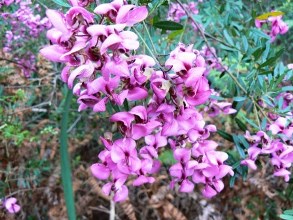 Virgillia oroboidesBlossom Tree, Keurboom (Virgilia oroboides)
There are two popular garden species; Virgilia divaricata and Virgillia oroboides. Both species are small to medium sized trees with feathery leaves and a rounded to broadly conical growth habit. They are very fast growing when young; V. divaricata grows from 6 to 10m in height, while V. oroboides can reach 10 to 15m tall. Both trees produce sprays of sweetly scented pea shaped flowers. V. divaricata has violet-pink flowers in spring and early summer while the blooms of V. oroboides are pinkish-white to white and generally appear in mid to late summer.
Members can click here for more info..
 GrewiaCross-berry, Kruisbessie, Mokukutu, Mogwane, iLalanyathi, Mulembu, umNqabaza (Grewia occidentalis)
This attractive medium sized, branching, woody shrub or small tree makes a most decorative garden subject and is grown for its starry, mauve or pink flowers in summer. It does not have an aggressive root system, making it perfect to plant near paving, and buildings. It is beautiful in the mixed shrub border, makes a good informal hedging or screening plant; and grows easily in containers. It can reach anything from 2 to 6m tall.
Members can click here for more info..
 Pavetta lanceolataWeeping Bride's Bush, Treurbruidsbos, umdleza, tshituku, umhleza (Pavetta lanceolata)
This plant is loved for its masses of sweetly scented, starry white flowers with ivory styles. The flowers can appear as early as September to January, but peak flowering time is November and December, and dense clusters of black fruits follow the flowers. Under optimal conditions it can grow between 4 and 7m tall; but in the average garden it will vary between 2 to 4m tall.
Members can click here for more info..
 Pavetta revoluta Dune Bride's Bush, Duinebruidsbos, umCilikishe, umHlabambaza (Pavetta revoluta)
This evergreen shrub or small tree is a joy to have in the garden with its glossy, dark green leaves and full, showy bunches of white flowers in late spring or early summer. It is highly recommended for small gardens, making a good specimen plant for the mixed border, and growing beautifully in a pot. It varies in height according to climate, but in the garden it should grow 2 to 3m tall and can spread as wide.
Members can click here for more info..
 Dodonaea viscosa. Picture courtesy Roger HootonSand Olive, Hop Bush, Sandolien, Ysterhout (Dodonaea viscosa angustifolia)
This plant is highly variable in growth habit, depending on climate, and occurs as a small to large, multi-stemmed shrub; or small tree with a single stem. In the garden it generally grows +-5m tall and 2.5m wide. The insignificant summer flowers are followed by showy three-winged seed pods which turn from green to a reddish-burgundy, then to brown and tan. It is perfect for small gardens and can be grown as a shrub or small tree. Plant in the mixed border or as an informal screen or hedge.
Members can click here for more info..
 Indigofera frutescensRiver Indigo, Rivierverfbos, umsipane, umnukambida (Indigofera jucunda)
This gracefully weeping, multi-stemmed plant can be grown as a small, single-stemmed tree, or as a large shrub. It is grown for its sprays of brilliant pink, to pale pink flowers in late summer and its soft green leaves. It makes a pretty, informal flowering screen and is highly recommended as a small shade tree for tiny gardens where light shade is required. It can also be trained into a fast growing standard and grows easily in a pot.
Members can click here for more info..
 Calpurnia aurea Wild Laburnum, Geelkeurboom, inDloli, umKhiphampethu, umLalandlovana (Calpurnia aurea)
The wild laburnum is perfect for small suburban gardens and townhouses because it has a non-aggressive root system. It makes a wonderful specimen plant if planted on its own in the lawn, but is also most effective if planted in groups. It also works well in a mixed shrub border, makes a great informal hedge or screen, and grows easily in large containers. It generally grows +-2 to 4m tall and 1.5 to 2.5m wide.
Members can click here for more info..
 Halleria lucida. Picture courtesy Paul LathamTree Fuchsia, Witolyf, Kinderbessi, Notsung, umBinza (Halleria lucida)
This plant makes a good specimen tree for the smaller garden because it does not have invasive roots; it also looks lovely if planted in groups, makes an excellent informal screening plant or hedge, and grows easily in large containers. It varies in height but generally grows +-2 to 5m tall in the garden. Orange to brick-red or yellow flowers are produced in the axils of the leaves and on short shoots on the old wood, and can appear anytime from May to January.
Members can click here for more info..
 Dias cotonifoliaPompom-Tree, Kannabas, inTozani, inTozwane emnyama (Dias cotinifolia)
This tree is a breathtaking sight when in full bloom, and smothered in a cloud of pink to pale lilac flower heads; flowers can appear from spring to mid-summer. It can be single or multi-stemmed, develops a dense round crown, and varies from +-4 to 6m tall, with an equal spread. It has non-invasive roots, making it perfect for small townhouse gardens and pot culture. It is a tough street tree; an excellent specimen tree on a lawn; and is great in the back of a large border.
Members can click here for more info..
 Bolusanthus speciosus. Picture courtesy www.lifeisagarden.co.zaTree Wisteria, Vanwykshout, mogaba, umHolo (Bolusanthus speciosus)
The tree wisteria is one of the most spectacular of our indigenous trees, and when in bloom rivals even the splendour of the Jacaranda. It is ideal for a small to medium-sized gardens, as it never grows too big and does not have an invasive root system. It also makes an excellent avenue or street tree. In larger gardens it can be grouped together to create a forest effect. In the garden it generally grows 4 to 8m tall.
Members can click here for more info..
 Rothmannia globosa. Picture courtesy www.lifeisagarden.co.zaSeptember Bells, Valskatjiepiering, umGubhe, umPhazane, thudwane, siKoba, siSwati (Rothmannia globosa)
September bells produces sweetly scented, creamy white flowers from August to November; which are more fragrant than the Gardenia. It is ideal for small gardens because it has a non-aggressive root system and can be planted near foundations etc. It can be trained to grow as a large shrub or small tree and does well in large pots. It looks lovely planted as a specimen tree, or in a small grove. This slender tree, usually grows from 3 to 4m tall in the garden.
Members can click here for more info..
 Rothmania Capensis. Picture courtesy www.lifeisagarden.co.zaWild Gardenia, Wildekatjiepiering, modulatshwene, mukubudu, umPhazane-mkhlu, iBolo (Rothmannia capensis)
The wild gardenia is suitable for even small gardens because it does not have an aggressive root system. It can be trained to grow as a large shrub or small to medium sized tree and does well in large pots. It looks lovely planted as a specimen tree, or in a small grove. The abundance of large, cup-shaped flowers usually appear from December to February. In the garden it will generally grow +-5 to 6m tall, with a 3 to 4m spread.
Members can click here for more info..
 Cussonia paniculata. Picture courtesy James GaitherMountain Cabbage Tree, Bergkiepersol, umSenge, mNgqokhwe (Cussonia paniculata)
This small tree has large, deeply indented grey-green leaflets, borne on top of a stout stem. No two cabbage trees grow exactly the same; some are tall with a straight trunk and others branch low down; therefore ultimate height varies from +-4 to 7m. The trunk is often crooked or curving; making it a particularly fine accent plant for small gardens. In large gardens it can be planted in groups for a dramatic effect. Do not plant close to buildings, walls and paving as the fleshy roots are invasive.
Members can click here for more info..
 Cussonia spicata. Picture courtesy James GaitherCommon Cabbage Tree, Gewone Kiepersol, umSenge, Motshetshe (Cussonia spicata)
This tree has large, bright green, deeply indented leaves, borne on top of a corky and fissured, grey stem. No two cabbage trees grow exactly the same; young trees are single stemmed but older specimens may have massive trunks with a much branched, roundish crown. Growth varies from +-4 to 10m tall with a spread up to 4m. It is a striking accent plant in the garden and can be planted singly or in clumps. Do not plant close to buildings, walls and paving as the fleshy roots are invasive.
Members can click here for more info..
 Ilex mitis Cape Holly, Waterboom, monamane, iPhuphuma, umDuma, phukgile, mutanzwa-khamelo (Ilex mitis)
The Cape Holly has a straight trunk and a dense, rounded crown of dark green leaves; it seldom grows taller than 8m. The small, sweetly-scented white flowers appear in spring or early summer. In autumn and winter the female plants bear heavy crops of small red berries. It loves growing near water and looks lovely if planted in groves. This plant needs to be shaped into a good shade tree. It makes a good hedging plant and can be clipped into almost any shape and size.
Members can click here for more info..
 Dombeya rotundifolia. Picture courtesy Merryl Joyce LeveringtonWild Pear, Drolpeer (Dombeya rotundifolia)
This beautiful flowering tree puts on a spectacular show in spring when masses of white flower clusters cover the entire tree; there is a also a pink form. It usually has a single stem with many branches and a rounded crown. Because it does not have an aggressive root system; it is an excellent avenue or specimen tree for gardens lrge and small. This tree is variable in height, growing +-4 to 12m tall, but in the garden it can be pruned into a small tree or large shrub.
Members can click here for more info..
 Dovyalis caffra fruit. Picture cortesy Tatiana GerusKei Apple, Keiappel, umkokola, amaqokolo (Dovyalis caffra)
This dense, spreading plant varies in growth habit from a shrub +-3 m tall, to an 8m tall tree with a thick crown. Bright orange-yellow fruits follow the flowers putting on quite a show in late summer. The fruit is edible and makes a great tasting jelly or jam. The stems and branches are armed with long spines, making it a perfect barrier plant for farms and large properties. It varies in height from +-3 to 8m tall and 2.5 to 3.5m wide.
Members can click here for more info..
 Carissa macrocarpa. Picture courtesy Lena DavisLarge Num-num, Natal plum, Grootnoemnoem, Amatungulu (Carissa macrocarpa)
This ornamental shrub or small tree has dark green waxy leaves, and produces white, sweetly scented, star-shaped flowers sporadically throughout the year. The bright red fruits are made into a delicious jelly. Its long, sharp spines make it a first class impenetrable hedge. It is ideal for formal topiaries or clipped box hedges and grows easily in containers. Plant it in the mixed shrub border or train it into a small tree. If left un-pruned it can grow +-5m tall and 2m wide.
Members can click here for more info..
 Rhus pendulinaWhite Karee, Witkaree, mosilabele, Garas (Searsia pendulina)
An excellent shade tree for small gardens with a low branching habit, but can be pruned into a single stemmed tree. It has fresh green willow-like leaves; and does not have an aggressive root system. Plant it as a specimen in the lawn or in groups. It thrives near water and because of its dense growth habit it makes a most effective windbreak or barrier for large properties. It can be clipped into a formal hedge. Un-pruned it will usually grow +-4 to 6m tall, and can spread almost as wide.
Members can click here for more info..
 Searsia lucidaGlossy Currant, Blinktaaibos, inHlokoshiyane (Searsia lucida)
This small indigenous tree or shrub is a decorative garden subject with its very glossy, dark olive-green leaves and naturally low branching habit, and somewhat drooping branches; usually growing between 2 to 3.5m tall. It makes an excellent coastal hedge or screen and can be planted as a pioneer species, to provide shade and shelter for slower growing trees like Milkwoods.
Members can click here for more info..
 Searsia chirendensisRed Currant, Bos-taaibos, muvhadela-phanga, inhlokoshiyane enkulu, umhlakothi, motha-thaa (Searsia chirindensis)
This graceful tree can be trained to grow as a small tree or large shrub. It is grown for its neat, rounded crown of large, soft green leaves which turn orange in autumn, and its coppery-red new growth. It does not have invasive roots and makes an excellent windbreak for farms and game farms. In the garden it normally grows about 7m tall and can spread almost as wide.
Members can click here for more info..
 Searsia lanceaKaree, Rooikaree, mokalabata, iNhlangutshane, Mosilabele, umHlakotshane, Mushakaladza (Searsia lancea)
This excellent shade treee has a low branching habit, producing multiple stems from ground level, but it can be pruned into a single stemmed little tree. It has a graceful weeping form, with a softly rounded crown; and because it does not have an aggressive root system, is suitable to grow around the home, in lawns, near paving and tarred surfaces. In the garden it normally reaches between 5 and 8m tall and can spread as wide.
Members can click here for more info..
 Calodendrum capense Wild Chestnut, Wildekastaiing, Molalakgwedi, Mbhovha, Muvhaha, umBhaba (Calodendrum capense)
The Cape Chestnut is a large handsome tree with a single trunk and a dense canopy of glossy, dark green leaves. In mid-summer the entire tree is completely covered with large sprays of spectacular white to pink orchid-like flowers. It has a non-aggressive root system, making it an excellent choice for large gardens or for street planting. In the garden it generally grows +-7 to 12m tall and 3 to 5m wide.
Members can click here for more info..
 Celtis africanaWhite Stinkwood, Witstinkhout, umVumvu, uSinga lwesalukazi, Modutu, Mpopano, mothibadifate, Lesika, mbholovisi (Celtis africana)
This popular fast growing shade tree is grown for its graceful shape, rich green leaves and silvery bark. It has a single stem and forms a thick spreading crown; growing +-10m tall and almost as wide. This excellent shade tree is beautiful on large properties and is perfect to plant in the middle of a large lawn. it is recommended for farms, game farms, schools, parks and parking lots.
Members can click here for more info..
 (Acacia erioloba) Camel Thorn. Picture courtesy Ruth PalssonCamel Thorn, Kameeldoring, Mogohlo (Acacia erioloba)
This is a valuable shade tree in semi-desert areas of the country. It varies greatly in height and spread, from a diminutive spiny shrub to a tall tree; in gardens it usually grows about 6 to 8m tall. It has the sharpest thorns of all the Acacias and produces a sweetly scented bright yellow flower balls in late winter and early spring. It is not suitable for small gardens but is an excellent choice for medium to large gardens.
Members can click here for more info..
 Acacia Galpinii. Picture courtesy Gareth BedfordMonkey-thorn, Apiesdoring, Tshikwalo, Molopa (Acacia galpinii)
This beautiful specimen tree has a rounded canopy and widely spreading branches. It provides dappled shade and is suitable for large gardens, avenues and parks. It is valued by farmers, providing shade and shelter for stock. The strong black thorns are hooked, making it ideal for a security hedge. Do not plant it close to buildings as it has an extensive root system. It varies in size from +-8 to 30m tall. Spikes of honey-scented creamy-yellow flowers appear in spring, before the new leaves.
Members can click here for more info..
 (Acacia xanthaphloe) Fever Tree. Picture courtesy DN MaguireFever Tree, Koorsboom (Acacia xanthophloea)
This tree has a beautiful form, unusual sulphur-yellow bark, small straight thorns, and sweetly-scented bright yellow flowers from September to November. It has a single, straight trunk and a roundish, spreading canopy. Because the shade it gives is sparse it makes a perfect specimen tree for the lawn. It is also an unforgettable avenue tree and is lovely planted in groups. This tree, varies in height and spread, depending on where it is grown, and can reach +-10 to 15m tall and 10m wide under optimal conditions.
Members can click here for more info..
 Acacia Karroo. Picture courtesy Guy FauconSweet Thorn, Soetdoring (Acacia Karroo)
The Sweet Thorn has a variable growth habit, depending on the climate in which it is grown. It generally has a spreading, rounded crown and makes a wonderful small to medium sized shade tree, reaching +-4 to 7m tall. It has stout white thorns and bears sweetly-scented, golden yellow flower balls between October and February. The long thorns make it an excellent barrier plant and it is planted extensively on farms to provide shelter and shade for stock. This tree has an aggressive root system and should not be planted too close to buildings, walls, etc.
Members can click here for more info..
 Protorhus longifolia Picture courtesy www.kloofconservancy.org.za Red Beech, Rooiboekenhout, Isifice, Ikhubalo, Mutu-musolde (Protorhus longifolia)
This is a handsome medium to large, evergreen tree grows quickly to 6 to 10m tall, but can occasionally reach 15m or more. It produces an attractive dense rounded crown of long, glossy dark green leaves, with the occasional bright red or yellow leaves dotted conspicuously throughout. It is is a wonderful specimen tree for gardens and parks; and is great to plant in dry gardens and also for attracting wildlife. It does not have aggressive roots but should be planted where it has room to develop.
Members can click here for more info..
 Syzygium cordatum Water Berry, Waterbessie, umDoni, umSwi, umJoni (Syzygium cordatum)
This evergreen flourishes near water and is a medium to large shade tree, with a tall, upright growth habit, and a lovely rounded crown. It varies in height from 6 to 15m, but has been known to reach up to 20m. The leaves are bluish green on top and paler green below; and the new growth is pinkish-red. Fleshy, deep pink berries follow the flowers, ripening to purple-black when mature. It is perfect for large properties and great for attracting wildlife, but needs to be planted well away from building foundations, paving etc. where it can be allowed to spread, and its strong root system will not cause damage. Planted close it makes a tall, fast growing screen or hedge.
Members can click here for more info..
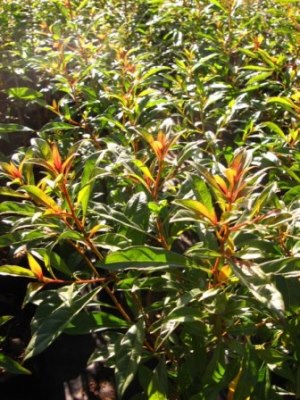 Heteropyxis natalensisLavender Tree, Laventelboom, iNkunzi, masepha, thathasani, mudedede, inkhuzwa (Heteropyxis natalensis)
This neat and well-shaped deciduous to semi-deciduous tree has a slender upright growth habit and a small rounded crown. The roots are non-invasive and the tree grows +-5 to 10 metres tall and 4 to 5m wide. The long, dark green glossy leaves have a subtle lavender scent when crushed. In spring new growth is flushed red and in autumn the foliage turns yellow to russet-red. In late summer inconspicuous but sweetly fragrant cream to pale yellow flowers appear in summer, followed by tiny brown seed capsules. The single main stem is crooked with bark, maturing to creamy-tan, with a contorted and flaky appearance.This tree is most useful where space is limited, or in beds where sun-loving smaller plants can still grow happily underneath. It is suitable for small gardens as well as large landscapes and is ideal planted in groups and groves.
Members can click here for more info...
 Vepris lanceolataWhite Ironwood, Witysterhout, Muruvula, Muhondwa, umZane, Umdlebe, Umngamazele, umOzana, Isutha (Vepris lanceolata)
A truly beautiful evergreen tree or shrub which varies greatly in height, depending on climate. In exposed coastal and arid regions it remains stunted, growing +-5m tall, while in forested areas it may reach up to 20m. The narrowly elliptic leaves release a lemony scent when crushed. The small star-shaped summer flowers are inconspicuous. The bark is smooth and grey to dark grey. The ironwood is one of the best choices for small gardens with its lovely shiny evergreen leaves which shimmer in even the slightest breeze, and their wonderful lemony scent. It does not have a very aggressive root system and responds well to pruning, so can be kept to any size. It can also be grown underneath the canopy of other trees in groves and forest gardens. This water-wise plant provides light shade and is a valuable food source for birds.
Members can click here for more info...
I
 Picture courtesy www.wildflowernursery.co.zaForest Bushwillow, Bosvaderlandswilg, modubu, imbondvo lemhlophe, muvuvhu-thavha, ulandile, umdubu wehlathi (Combretum kraussii)
The forest bushwillow, with its attractive shape and dense canopy, is one of our most decorative garden trees. It varies in size from 5 to 15m tall with a 4 to 8m spread, depending on climate and has a well-shaped crown and a single trunk about 80cm in diameter, with a smooth grey to dark grey bark which becomes flaky with age. This tree is classified as mostly evergreen or semi-deciduous, as the spring leaves only partially replace the old foliage. Its beautiful spring and summer foliage, white flowers and eye-catching winged fruits, together with the rich hues of its autumn and winter foliage, make it a good all year round tree. It will grow in sun and shade, is low maintenance, fast-growing, and tolerates moderate drought and frost. The forest bushwillow makes an excellent specimen shade tree and is suitable for small gardens. Because it can be planted in groves it is also useful when adding background foliage to large garden beds.
Members can click here for more info...
 Picture courtesy www.wildflowernursery.co.zaParsley Tree, Pietersielieboom, mmakatlala, monkhoane, umbangandlala, serethe, muthatha-vhanna (Heteromorpha arborescens)
The parsley tree is deciduous, fast growing and drought-resistant, with striking bark and a graceful shape; making it an attractive garden tree for all seasons. It is a small to medium-sized and varies in height between 3 to 7m tall with a 3 to 5m spread. It usually produces a single stem which becomes crooked with age; but can also be multi-stemmed. Its characteristic bark is papery and peels in rings, exposing the gorgeous, shiny, smooth and waxy, golden-brown under-bark. The soft, droopy leaves are light green to grey-green and depending on climate, the leaves may turn yellow and red before falling in autumn. Anytime from January to April conspicuous round sprays of greenish-white to yellow flowers appear, resembling a huge powder-puff. The fruits are also carried in bunches, consisting of small three-winged, oval capsules that turn cream-brown when ripe. This is an attractive and unusual garden tree for all seasons, and because it does not have destructive roots, is suitable for both small and large properties.
Members can click here for more info...
I
 Picture courtesy www.kumbulanursery.co.zaBurke's Fig, Common Wild Fig, Gewone Wildevye, Umthombe, Mmadintana, Moumo, Muumo, Umtende (Ficus burkei)
Burke’s fig is a medium to large sized tree, 10 to 18m tall, with a well-shaped crown that can spread twice as wide as it is tall. In wetter habitats it remains evergreen but may be briefly deciduous in drier climates. Like others in the Ficus genus, it shares a common "strangling" growth habit that is found in many tropical forest species. Ficus species are highly recommended shade trees, often used on farms, large estates, schools and recreational areas. If truncheons are planted closely together, they can stabilise the soil on slopes and prevent soil erosion. Because they have aggressive root systems, they should not be planted in a small garden or near buildings, swimming pools or pathways. The fruits ooze latex when broken off, so they are also not suitable for car parks, and should not be planted near dams or fish ponds, as the latex clogs the gills of fish. If your garden is too small for a Ficus, why not grow it in a large container on the patio or train it into a bonsai.
Members can click here for more info...
 Picture courtesy www.wildflowernursery.co.zaCommon Bush-cherry, White-wood, Gewone Witbos, Bead-bean Tree, (Maerua)
Maerua cafra is an evergreen shrub or small tree that grows 2 to 10m tall. Plant growth is variable, depending on local climatic conditions. In dry regions and on the sand dunes it can occur as a straggly shrub, but in wetter regions can grow as a small tree, up to 9m tall. The bark is mottled with white, and the green leaves are broadly elliptic. Scented flowers appear in early spring, from August to October. They are borne in terminal clusters and consist mainly of a tuft of spreading white stamens, tipped with green. The slender stamens give the flowers a spider-like appearance. The flowers are followed by oval, plum-like, pale green fruits, in October to December, which are relished by many different bird species. Because it is slow growing, it is seldom seen for sale but hopefully some keen growers and gardeners will make the effort to cultivate this plant.
Members can click here for more info...
Insert here
Insert here