


Paintbrush Lily, Rooikwas, idumbe-lika-nhloyile, isiphompho, Idumbelentaba, umgola, Lekgokgoo, Thokgola, umphompho wezinja - Scadoxus
 Scadoxus multiflorus 'Katharinae'Condensed Version:
The spectacular paintbrush lily is one of South Africa's most striking bulbous plants and remains a popular ornamental garden subject in warmer climates around the world, not only for its brilliantly coloured flowers, but also for its attractive tropical foliage. Because it is an excellent candidate for container planting, in colder climates it can still be grown successfully, even indoors. It thrives in the filtered light in woodland gardens and shady rockeries; and is perfect to plant amongst grasses and essential for all wild, butterfly and bird gardens.
The paintbrush lily is tender to frost and does not enjoy very low temperatures. Plants may be grown directly in the ground in frost-free regions, but in cold regions the bulbs are planted directly in the garden in spring after the last frost date, and lifted prior to first frost in winter. The paintbrush lily is an excellent candidate for container planting because the plants perform best when root-bound and generally dislike root disturbance. Whether you are planting in containers or in the ground, the paintbrush lily requires organically rich, well-drained soils. Position the plants where they receive semi-shade or even full shade, and plant the rootstock just below the ground. Provide consistent and even moisture during the growing season, but keep reasonably dry in winter. In winter rainfall areas the plant has no trouble surviving the wet winters, provided it is in a well-drained position. The plants benefit greatly from regular liquid feeding during their growing season, and to keep them looking neat, remove the spent flowers unless you are collecting the seed.
If you are growing your bulbs indoors, place the pot in bright, filtered light but no direct sunlight. Water freely when in growth and apply a dilute, balanced liquid houseplant fertiliser each month during the growing season.
 Scadoxus puneciusFull Version:
Description, History & Interesting Facts
The spectacular paintbrush lily is a member of the Amaryllis family (Amaryllidaceae) and one of South Africa's most striking bulbous plants with its large, glossy green tropical leaves, brilliant bright-red paintbrushes and fat red fruits. The name Scadoxus is derived from "doxus" meaning glory or splendour, and ‘’punicues’’ meaning crimson, scarlet or purple. The 9 species are found in tropical Africa and the Arabian Peninsula, where they can be found growing wild in tropical woodlands. Three species: S. puniceus, S. multiflorus and S. membranaceus occur in South Africa. Scadoxus was formerly classified as Haemanthus to which it is closely related, but was separated in order to distinguish those plants with elongated stems (Scadoxus) from those with broad, stemless leaves (Haemanthus).
Scadoxus species are usually available at specialist indigenous nurseries or at your local National Botanical Garden. Because many of these plants are indiscriminately removed from the wild and sold when they are in flower, be sure not to purchase them alongside the road or from sellers who cannot assure you of the plant's origin.
(Scadoxus puniceus)
Scadoxus puniceus is the most well-known of the species and can be found growing naturally in shady areas in ravines and forests as well as in coastal bush. Occurring from tropical Africa into the Northern provinces of South Africa and Swaziland, Gauteng, the Free State, KwaZulu-Natal and the eastern and southern Cape, this summer growing species can be found growing in both shade and full sun and is completely dormant during the winter months. It is quite variable, with a number of different forms occurring throughout its distribution range.
Flowering times also vary; in the northern and eastern parts of the country blooms will appear in spring or early summer, just as the new leaves start to develop, whereas those from the southern parts can expect flowers towards the end of the growth cycle in early autumn. Each bulb produces a single flower stalk which may reach 50cm to 1m tall, and is often speckled with reddish-purple near the base. The large dense flowering head, up to 15cm across, consists of hundreds of tiny, densely-packed flowers with bright yellow anthers, snuggled within red bracts. Six to eight leaf stems are produced and are held erect by clasping together at the base of the plant to form a pseudo stem (false stem). The tropical glossy leaves remain attractive during the growing season until it gets cold. Shiny, fleshy, orange-red berries follow the flowers and are relished by birds and monkeys. The large underground bulbs may be up to 10cm across and have a short thick stem at the base from which numerous fleshy roots arise. The plants use their bulbs and roots to store moisture during their dormant season.
(Scadoxus multiflorus)
Scadoxus multiflorus is a deciduous summer growing species that consists of three subspecies, namely, multiflorus, katharinae, and longitubus. It is found predominantly in all but the very driest regions of tropical Africa, but has a wide distribution and varying habitats. Its range includes Swaziland, Mozambique, Zimbabwe, Namibia and Botswana; all four Northern provinces of South Africa, KwaZulu-Natal and the Eastern Cape. It grows abundantly in shady, moist coastal and swamp forests to mountain forests, secondary forests and forest margins, savannah woodland and open grasslands. It is also very common in the shade of trees near river banks.
(Scadoxus multiflorus subsp. Katharinae)
This is a robust evergreen, with a very short to no dormancy period in cultivation. It is arguably the most spectacular of the genus and commemorates the English botanical artist and plant collector Katherine Sunders, who arrived in Natal in the mid 1850’s. It remains the most commonly and easily grown Scadoxus which tolerates even heavy shade and multiplies rather rapidly by rhizomes. The pseudostem is sturdy and is usually spotted with purple but can be plain and almost white. The leaves can stand up to 70cm high and the flower stems are produced in late summer to early autumn (December to March) when the plant is in full leaf, and a single flower-head can reach a diameter of 25cm and a height of 110cm, which is nearly waist height! Each flower is pinkish-orange-red with protruding stamens carrying bright yellow anthers. The green berries turn scarlet as they ripen during winter and spring, and these decorative berries can remain on the plant for up to 2 months.
(Scadoxus membranaceus)
Scadoxus membranaceus is one of the smaller species of Scadoxus and lacks a pseudostem. It is evergreen and grows wild in the coastal sand dunes of the South-Eastern Cape to KwaZulu-Natal in the north. It can also be found growing on rocks as a lithophyte, where there is sufficient accumulated material to form an open rooting medium. It is a very variable plant, attaining heights from 15 to 40cm and grows best in deep shade. The bright orange flowers are enclosed by four conspicuous greenish-brown bracts followed by the fat, bright red berries. This species is an ideal pot plant.
 Scadoxus puniceusUses:
The large flower clusters of the paintbrush lily are a butterfly and bird magnet and make excellent cut flowers. Although this bulb is very poisonous, it is widely used in traditional medicine to treat coughs and gastro-intestinal problems. It has also traditionally been used as part of a medicine taken regularly during pregnancy to ensure a safe delivery.
In the Garden:
The paintbrush lily has been in cultivation in Holland since the early 18th century and remains a popular ornamental garden subject in warmer climates around the world, not only for its brilliantly coloured flowers, but also for its attractive tropical foliage. Because it is an excellent candidate for container planting, in colder climates it can still be grown successfully, even indoors. It thrives in the filtered light in woodland gardens and shady rockeries; and is perfect to plant amongst grasses and essential for all wild, butterfly and bird gardens. Sunbirds, weavers and other birds relish the nectar, as do a myriad of insects, which in turn attract insect eating birds to the plants.
 Cultivation:
The paintbrush lily is tender to frost and does not enjoy very low temperatures. Plants may be grown directly in the ground in frost-free regions, but in cold regions the bulbs are planted directly in the garden in spring after the last frost date, and lifted prior to first frost in winter. Over-winter the bulbs by placing them in in cardboard boxes and covering them with peat or vermiculite, before storing in a dry cool area. Alternatively, the bulbs can be planted into containers which can be moved in winter. Reduce watering in late summer and bring the containers indoors or move them to a spot for overwintering where it is cool and dry.
Regardless of climate, the paintbrush lily is an excellent candidate for container planting because the plants perform best when root-bound and generally dislike root disturbance. They also don't need huge pots to grow and bloom well. When you really do need to re-pot, do so when they are dormant, or for the evergreens, just before new growth begins in spring. Whether you are planting in containers or in the ground, the paintbrush lily requires organically rich, well-drained soils. Position the plants where they receive semi-shade or even full shade, and plant the rootstock just below the ground. Provide consistent and even moisture during the growing season, but keep reasonably dry in winter. In winter rainfall areas the plant has no trouble surviving the wet winters, provided it is in a well-drained position. The plants benefit greatly from regular liquid feeding during their growing season, and to keep them looking neat, remove the spent flowers unless you are collecting the seed.
If you are growing your bulbs indoors, place the pot in bright, filtered light but no direct sunlight. Water freely when in growth and apply a dilute, balanced liquid houseplant fertiliser each month during the growing season.
Propagation:
Most species can be grown easily from fresh seed without a lot of trouble but will take about 4 years to flower. Collect seeds when they have turned red and fall easily into your hand when touched. Remove the fleshy coating before sowing on the surface of a moistened potting soil mix. Fresh seeds will germinate fairly quickly but will not produce leaves right away. Instead, all of the energy will be put into producing a small ‘bulblet’ which will sit dormant for a few months before any leaves emerge. During this time, keep the medium somewhat moist but soggy.
 Problems, Pests & Diseases:
Scadoxus are relatively healthy plants but watch out for the Amaryllis lily borer which can cause severe damage to the whole plant. Slugs and snails can also damage the foliage extensively.
Warning:
As within many of the closely related amaryllids, this bulb contains poisonous alkaloids and deaths have been reported following the ingestion of the bulb.
Spekboom, Porkbush, Elephant’s Food, iNtelezi, isiDondwane, iGqwanitsha, Tshilepwete - Portulacaria afra
Spekboom, Porkbush, Elephant’s Food, iNtelezi, isiDondwane, iGqwanitsha, Tshilepwete - Portulacaria afra
Spekboom, Porkbush, Elephant’s Food, iNtelezi, isiDondwane, iGqwanitsha, Tshilepwete - Portulacaria afra
Spekboom, Porkbush, Elephant’s Food, iNtelezi, isiDondwane, iGqwanitsha, Tshilepwete - Portulacaria afra
Condensed Vers Portulacaria afraion:
The spekboom is easy to grow and although it is known to be a great drought tolerant plant which is perfect for water-wise gardens, it will even grow in well-watered garden beds as long as the soil drains well. Because it is drought tolerant and also fire resistant, the spekboom is excellent for firescaping properties which are susceptible to wildfires. It is also a good soil binder, helping to prevent soil erosion.
The low growing forms make excellent groundcovers and look spectacular in hanging baskets, or as part of a mixed succulent dish garden. The upright forms can be clipped into a hedge or informal screen. This succulent will thrive indoors if placed in a warm room with bright light.
The spekboom is an attractive evergreen succulent with its small round emerald-green leaves, borne on startling-red stems. In the garden it will grow moderately to a height of about 1.5 to 2m, but can mature into a small tree 2 to 5m tall. In the wild, a myriad of small star-shaped pink flowers are produced in clusters at the ends of the branches from late winter to spring, although flowering in cultivation can often be erratic. Pollinated flowers are followed by tiny, papery and transparent 3-winged fruits which resemble pinkish lanterns, each with a single seed.
Various different forms are found in cultivation, most of which originate from the Karoo Desert National Botanical Garden in South Africa.
Portulacaria is generally suited to all regions of SA but is not ideal to grow outdoors in heavy frost areas. It is an easy to grow succulent that is heat, drought and fire resistant, and can be grown in full sun or semi-shade. If your garden soil is fertile no feeding will be necessary except for a good mulch of compost each spring to encourage new growth. The spekboom takes well to pruning and can be clipped into shape as required.
Full Version:
Description, History & Interesting Facts:
The spekboom belongs to a large and widespread family (Portulacaceae) which includes the popular summer flowering annual Portulaca, although this annual is not a South African species. Portulacaria afra has a growing reputation for saving the planet and recent research has dubbed the spekboom "an excellent carbon sponge" because of its ability to absorb more free carbon from the atmosphere than most other plants. Studies have shown that this amazing succulent can store more than four tons of carbon per hectare, creating what is called a "carbon sink" when planted in large plantations, and making it one of the best plants to grow in order to combat warming of the earth's atmosphere. In fact, this beautiful yet unassuming succulent has become so famous it even has its own Facebook page!
 Portulacaria afra prostrate 'Gold'(Portulacaria afra)
Portulacaria afra is found in warm situations on rocky outcrops and slopes in succulent Karoo scrub, thicket, bushveld, and dry-river valleys in the eastern parts of South Africa, from the Eastern Cape northwards into KwaZulu-Natal, Swaziland, Mpumalanga, Limpopo and further north into Mozambique. The spekboom is a strikingly attractive, evergreen succulent with its small round emerald-green leaves, borne on startling-red stems.
In the garden it will grow moderately to a height of about 1.5 to 2m, but can mature into a small tree 2 to 5m tall. Although a succulent, the trunk and branches have a woody inner tissue, and the stiff, irregularly arranged branches will grow into a thicket if left unpruned. Heavy branches may break off, often rooting where they fall and starting new plants.
In the wild, a myriad of small star-shaped pink flowers are produced in clusters at the ends of the branches from late winter to spring, although flowering in cultivation can often be erratic. Pollinated flowers are followed by tiny, papery and transparent 3-winged fruits which resemble pinkish lanterns, each with a single seed. The flowers are a rich source of nectar for many insects, which in-turn will attract many insectivorous birds. This plant is also called "Elephant Food" in the Eastern Cape because it forms part of the diet of the Addo elephants in the Addo National Park.
Various different forms are found in cultivation, most of which originate from the Karoo Desert National Botanical Garden in South Africa.
(Portulacaria afra 'Limpopo')
'Limpopo' is a large-leaved natural form which represents the northern populations which extend into the northern provinces of South Africa and Mozambique. It has much larger more ovate leaves that can measure up to 20 to 30mm long and 15 to 20mm wide.
(Portulacaria afra 'Prostrata')
'Prostrata' is a low-lying, decumbent form, growing 10 to 20cm tall, with small, glossy green leaves. This spekboom looks wonderful if allowed to cascade over a low wall or rockery, or planted in a Loffelstein type retaining wall, hanging basket or pot. It also makes a wonderful groundcover and contrast plant under Cycads or other form plants.
(Portulacaria afra 'Aurea’)
'Aurea' is a compact, upright form with rounded leaves that go bright yellow in the sun. It is lovely in containers and a wonderful contrast plant in the garden.
(Portulacaria afra 'foliis variegata')
'Foliis Variegata' is a popular and highly adaptable variegated form with creamy-yellow mottled leaves and nearly horizontally branches that sprawl on the soil, seldom growing over 20cm tall. This slow growing form is well suited to container culture and a beautiful contrast plant in the garden.
(Portulacaria afra 'Medio-picta')
'Medio-picta' is a ground hugging form which grows slowly and can be planted in full sun to light shade. Its attractive stems are a bright reddish-pink and the small green leaves have wide white stripes down their middle, sometimes with little or no green. This great garden plant makes an excellent ground cover and also looks gorgeous spilling over containers or low walls.
(Portulacaria afra 'Variegata')
'Variegata’ has a compact, upright form with white or cream edged, pale green leaves with pink highlights. It does not tolerate bright sun as much as the species and is perfect as a contrast plant in the shade garden and grows easily in containers.
(Portulacaria afra 'Tricolor')
‘Tricolor’ has a lovely pendulous habit and the green leaves are variegated with yellow and pink. It is very striking cascading down almost anything. This form may appreciate some shade, especially in very hot regions.
(Portulacaria afra ‘Cork Bark’)
‘Cork Bark’ is slow growing with the main trunk having thick fissured corky grey bark, from which emerge reddish brown stems holding long emerald green leaves. It can be planted in sun or shade and works as a great bonsai plant or small specimen shrub. Cork bark was selected by bonsai specialist Dave Bogan who first noted its fissured, corky bark in a Florida nursery in the 1960s. Its corky trunk was first thought to be caused by a fungal disease but later recognized as a natural aspect of the plant, with bright light and lean conditions seeming to promote the best fissured bark, but it should also be noted that this is a slow process, requiring considerable patience.
 Portulacaria afra 'Big Leaf'Uses:
Besides being excellent for binding atmospheric carbon, the spekboom is browsed my many wild and domestic animals, and is a favourite of tortoises. The leaves have a sour or tart flavour, and humans are also known to chew on the juicy leaves for their health benefits. It is also used in salads and stews, and it has been recorded that a small sprig of spekboom, steamed with a tomato bredie, imparts a delicious flavour. Also, the honey made from the flowers is reputed to have a remarkable flavour and texture.
Traditionally the leaves are chewed to increase the breast milk of lactating mothers, and as a treatment for sore throats and mouth infections. The leaves are also used to quench thirst, and sucking on a leaf is used to treat exhaustion, dehydration and heat stroke. Crushed, leaves are rubbed onto the feet to relieve the pain of blisters and corns, and the astringent juice is applied to skin as a treatment for sunburn, pimples, rashes and insect bites or stings.
In the Garden and Home:
The spekboom is so easy to grow and although it is known to be a great drought tolerant plant which is perfect for water-wise and xeriscape gardens, it will even grow in well-watered garden beds as long as the soil drains well. Because it is drought tolerant and also fire resistant, the spekboom is excellent for firescaping properties which are susceptible to wildfires. Click here to read my articles on Firescaping Your Property.
It is also a good soil binder, helping to prevent soil erosion, and is used for restoration purposes in semi-arid landscapes and thicket vegetation. It has also shown good results when grown as a "green roof plant", where much larger plants are able to be grown.
All forms of this versatile plant are easy to grow in containers and the cork bark form makes an excellent and handsome bonsai for indoors or outdoors. The low growing forms make excellent groundcovers and look spectacular if planted in in hanging baskets, or as part of a mixed succulent dish garden.
The upright forms can be clipped into a hedge or informal screen, and the medium fine texture of their foliage makes a good contrast to wide-leaved annuals or perennials such as coleus or heucheras. The reddish colour of the stems also coordinates well with plants with red, purple or dark foliage.
 Portulacaria affra makes a good hedgeCultivation:
Portulacaria is generally suited to all regions of SA but is not ideal to grow outdoors in heavy frost areas. It is an easy to grow succulent that is heat, drought and fire resistant, and can be grown in full sun or semi-shade. Although it is very drought tolerant, with adequate water it will grow much quicker and the foliage will be lusher, but be careful not to overwater, as it is susceptible to root rot in consistently moist soil. In the garden it can be watered together with neighbouring plants as long as the soil drains well.
The spekboom is hardy to moderate frost and in the wild large plants survive the winter frosts by growing dense enough to provide their own natural cover. The tops of the plants will become burnt but the underlying layers will be protected. If your garden soil is fertile no feeding will be necessary except for a good mulch of compost each spring to encourage new growth. The spekboom takes well to pruning and can be clipped into shape as required.
This succulent will thrive indoors if placed in a warm room with bright light. Too much direct sunlight can cause the leaves to turn yellow or red at the tips – which some people prefer – but it may also burn the leaves. Therefore, it may require some experimentation with locations to find the perfect spot for your spekboom.
Perfect drainage is especially important if you are planting into containers and unglazed pottery is best to allow for better evaporation of excess moisture. A regular potting soil to which liberal quantities of washed river sand is added can be used for potting. Don’t leave a saucer full of water underneath the container or the plant may rot. Rather, fill the saucer with fine gravel and place the pot on top so excess water cannot reach the drainage holes. Water your plant only when the potting soil is dry or almost totally dry, and in cold winter regions restrict watering to a minimum in winter. Feed potted specimens monthly during the growing season with a liquid plant food and repot when the plant has filled the container or the roots can be seen growing out the drainage holes.
 Portulacaria tricolorPropagation:
The spekboom is easily propagated from cuttings or truncheons which strike roots easily without a rooting powder and can even be planted directly into the ground where they are to be grown. Alternatively, cuttings can be taken in the normal manner and planted in washed river sand. Keep slightly moist in a warm shady position until the rooted cuttings are ready to be planted out, after four to six weeks.
Pests & Diseases:
This plant has few pests, but watch out for mealybugs, spider mites and whitefly, which can become, especially indoors. Like many succulents it does not tolerate some pesticide sprays. Petroleum-based chemicals should be avoided, or test first on a few leaves to be sure the material will not damage the leaves.
Peace Lily, White Sails, Spathe Flower – Spathiphyllum wallisii
Popular flowers for hot summer gardens
 Does your summer flower garden start to fizzle out as soon as the really hot weather arrives? If so, you need a new plan to keep your beds blooming. The good news is that while many plants and flowers seem to be fainting away, there are others which just breeze through the mid-summer heat.
If you plant a framework of hardy perennials now, which will bloom again next season, inter-planted with summer annuals which thrive in the heat, your garden will not only look great this summer, but next season as well. Reducing the amount of summer annuals you need to plant each season will not only save you a lot of cash but also a lot of time. Also, many of these plants are water-wise and will save you on water bills. You can experiment a little each season until you find combinations that suit you, your garden, and your climate.
Many plants perform best in poor soil, but add a little compost if your soil is very poor. Most other plants will benefit greatly if the beds and planting holes are well-prepared, so do not skimp on spending money on compost if your soil requires it, as well as some fertiliser to get your plants off to a good start. Organic matter and mulching will help to keep the soil cool and retain moisture, thus saving on water bills.
The following flowering plants are as tough-as-nails and will provide you with the colour you want, while tolerating the most intolerable summer heat.
Insert here
 Scaevola 'Blue Horizon'Fan-flower (Scaevola aemula) is a prostrate and spreading little evergreen plant which produces lovely purple, blue, mauve or white flowers continuously during warm weather. It thrives in coastal gardens, tolerating salt spray, sandy soil and periods of drought. It loves full sun but will take light shade. It will trail down beautifully if planted in hanging baskets and window boxes; and also makes a wonderful groundcover and edging plant.
Members can read more here..
 Arctotis Radience Red. www.newplant.co.zaAfrican Daisy (Arctotis) is a low-growing spreading plant that loves full sun and is excellent to control soil erosion at the coast. The plants produce a dazzling display of flowers for most of the year in mild climates and are available in all shades of orange, yellow and red as well as plum, pink and cream. This plant makes a most effective ground cover and looks wonderful spilling over walls or a dry bank.
Members can read more here..
 Gaillardia 'Arizona Sun'Blanket Flower (Gaillardia) blooms from spring to autumn and thrives in hot, humid regions and tolerates drought once established; making them great water-wise garden plants. They are evergreen, love full sun and are hardy to frost. Flowers come in reds, oranges and yellows and the plant grows about 45cm tall and 45cm wide.
Members can read more here..
 Coleus mixedColeus are popular summer annuals that are easy to grow in the shade. Their colourful leaves are often blotched or variegated and come in a variety of attractive shapes and sizes; and in many startling colours and combinations of colours. A large number of cultivars have been bred and coleus is available in shades of green, yellow, pink, red and maroon.
Members can read more here..
 Angelonia 'Angelmist' www.ballstraathof.co.zaSummer Snapdragon (Angelonia) is called summer snapdragons because they can take heat and full sun, but they will still flower in very light shade. These ‘toughies’ will even withstand heavy thunderstorms and are loved for their snapdragon-like flowers, born on slender upright spikes. They bloom continuously during the hot summer months and hybrids are available in clear flower colours or two-toned combinations of rose, pink, blue, lilac, violet-blue, purple, and white.
Members can read more here..
 Callibrachoe 'Peach'Million Bells (Calibrachoa) are closely related to petunias and look like a miniature petunia, growing about 30cm tall and spreading up to 60cm wide. They love full sun and will add a bright touch to any landscape, providing an abundance of brightly coloured blooms from spring to the first frosts. The flowers are available in many sizzling shades of cherry, red, rose, pink, violet, blue, yellow, lemon, terracotta and white and will flower all year round in temperate climates.
Members can read more here..
 Dahlietta Connie Dahlia. Picture courtesy Ball Horticultural CompanyDahlia These beautiful cut flowers come in many shapes and sizes, from small, ball-like poms to huge dinner-plate decoratives. The colours cover almost every conceivable shade, and combination of colours. They are as tough as they are beautiful and thrive in full sun, but in extremely hot regions will appreciate some shade at midday.
Members can read more here..
 Sparkler Blush Cleome. Picture courtesy Ball Horticultural CompanySpider Plant (Cleome) is an easy to grow annual plant which grows well throughout the country, producing spectacular flowers on stems reaching as high as 120cm. It has attractive large green leaves and blooms continually throughout summer. The flowers are available in soft pastel shades of pink, rose, white and lilac. It grows easily from seed and loves full sun, but in extremely hot regions appreciates some midday shade.
Members can read more here..
 Sunflower 'Ballad'. Picture courtesy Ball Horticultural CompanySunflowers (Helianthus) thrive in the heat and full sun. They grow quickly and easily and will delight with their large cheerful blooms that turn towards the sun throughout the day. There are both dwarf and tall strains and the modern hybrids are available in shades of golden-yellow, lemon-yellow, orange and red. There are numerous forms, both single and double, and the taller garden varieties vary in height from 1.2 to 3m tall and the dwarf varieties from 30 to 60cm tall.
Members can read more here..
 Sonata Carmine Cosmos. Picture courtesy Ball Horticultural CompanyCosmos grows best in the worst conditions - hot and dry; doing well in the drier summer rainfall regions of the country. They thrive in full sun but do not enjoy high humidity. Flowers are available in shades of pink, crimson and white and hybrids vary in height from 40 to 100cm tall. Modern hybrids are compact and very free-flowering, and the dwarf strains are charming if planted in containers. Cosmos sulphureus has striking orange, semi-double flowers.
Members can read more here..
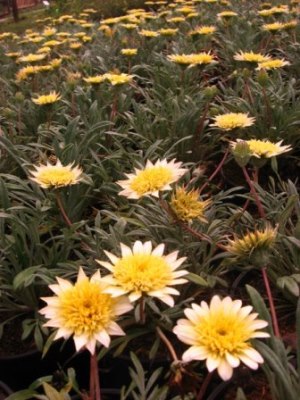 Gazania 'New Moon' www.newplant.co.zaGazanias are very adaptable and thrive in many habitats, tolerating salt laden air, strong winds and moderate frost. There are a number of subspecies, cultivars, and hybrids available from garden centres, each with its own unique growth habit, with both trailing and clump forming varieties. Hybrids are available in a choice of colours ranging from bronze to red, orange, pink, yellow, cream and white. These tough little plants require very little maintenance and make fantastic garden plants, provided they are not overwatered and are planted in full sun.
Members can read more here..
 Nicotiana Nicki Red. Picture courtesy Ballorticultural CompanyFlowering Tobacco (Nicotiana) are tough shady garden classics which tolerate humidity and high temperatures. They grow well throughout South Africa as long as they are watered regularly and are protected from strong wind. They love to grow in semi-shade but will take more sun in cooler regions. In very hot regions plant them where they will receive midday and afternoon shade. Modern hybrids are compact growing and flower for a long period in summer. The tubular flowers are available in red, pale yellow, pink, lilac, burgundy, lime, green, and cream and white.
Members can read more here..
 Cooler Red Vinca. Picture courtesy Ball Horticultural CompanyVinca (Catharanthus) thrives in hot, dry or humid climates and is one of the most reliable plants to grow in the blazing sun. It loves the heat and does not like to be overwatered, making it the perfect choice for water-wise gardens. Vinca produces charming phlox-like flowers in many shades of pink, carmine, blush, coral, peach, mauve, burgundy and white, from spring to the first frosts; and in temperate regions will bloom all year round.
Members can read more here..
 Clown Blue Improved Torenia. Picture courtesy Ball Horticultural CompanyWishbone Flower (Torenia) can take heat, humidity and shade, and there are not many annuals that can accomplish that. In cooler regions it will also take full sun and blooms consistently all summer through autumn, until the first frosts. The intense flower colours range from light and dark blue, to burgundy, pink, rose; lavender and white. Seedlings will grow quickly to about 20cm tall and 15cm wideand require regular watering.
Members can read more here..
 Petunia Daddy mix Petunia. Picture courtesy Ball Horticultural CompanyPetunias thrive in full sun and can be planted almost all year round. They are perfect for the dry summer rainfall regions because excessive rains will ruin the flowers and can cause the plants to rot. Petunias are susceptible to fungal diseases in humid climates. Thousands of hybrids have been bred and flower sizes and shapes vary greatly. Petunias are available in an array of colours from fiery reds, burgundy and purples, to all shades of pink, lilac, blue, yellow and white; blooming continuously all season with very little maintenance.
Members can read more here..
 Portulaca YellowPortulaca loves full sun and is very tolerant of summer heat but does not like humidity. These prostrate, spreading plants remain popular summer annuals because they don't require a lot of water and work really well in a xeriscape (dry) garden setting. Their masses of double; brilliant jewel-toned blooms are available in shades of rose, pink, red, purple, lavender, yellow, orange and white, and are often striped or spotted with contrasting colours.
Members can read more here..
 Zahara White Zinnia. Picture courtesy Ball Horticultural CompanyZinnias grow are easy to grow annuals which thrive best in climates with long, hot, dry summers. In humid regions they are susceptible to fungal diseases but new and improved varieties like 'Zahara' are available that are more resistant to fungal diseases. There are at least a hundred cultivars, in a diversity of flower colours and types, and in all shades of white, cream, green, yellow, apricot, orange, red, bronze, crimson, purple, pink and lilac. There are double, semi-double and dahlia-like "pompon" flowered varieties that range from dwarfs not exceeding 15 cm in height to cut flower beauties that reach up to 90cm.
Members can read more here..
 Aztec Violet Verbena. Picture courtesy Ball Horticultural CompanyVerbena There are hundreds of cultivars varying in flower colour and growth habit, with erect and bushy varieties, as well as trailing and mat forming ones. The flowers are borne profusely in dense clusters all summer and come in shades which include white, pink, crimson, scarlet, vermilion, purple, blue, and yellow. Their main requirements are full sun and once established verbenas require very little water; making them ideal for hot dry sites. In extremely hot and dry regions they will need more regular watering to look at their best, and may appreciate some relief from the hot midday sun. Verbenas are susceptible to fungal diseases, especially in very humid regions.
Members can read more here..
 MarigoldMarigolds (Tagetes) grow well throughout the country and are the work horses of the summer garden, blooming virtually non-stop. They love full sun, grow well on poor soils and dislike being over watered. Marigolds come in all shapes and sizes, from dwarf to tall growing, and single or double varieties; all with intense flower shades and mixtures of orange, yellow, gold, maroon, and mahogany, flame red and light creamy-yellow.
Members can read more here..
 Cabaret Yellow Calibrachoa. Picture courtesy Ball Horticultural CompanyMembers have full access to our Plant Index, so why not spoil your-self with a subscription to this website - our prices are affordable for everyone.
Sign up here..
Insert here
Tree Houseleek, Irish Rose – Aeonium
 Aeonium arboreum albovariegatum. Picture courtesy Scott - check out his flickr pagesCondensed Version:
Houseleeks vary in size from small specimens which grow almost flat against the ground to woody shrubs with stout basal stems which can reach 1.5m tall or more, supporting multiple waxy rosettes on a basal stem. Their gorgeous spoon shaped leaves can be glossy or matte and come in shades of burgundy and green, sometimes variegated with splashes of palest gold.
The spring or summer flowers are star-shaped and typically yellow, but can sometimes be creamy-white or pink. These are borne on mature plants in pyramid shaped clusters at the end of the stems. Some have breath-taking inflorescences and others ore not very impressive. Extensive hybridization has expanded their range considerably and today aeoniums are without a doubt, some of the most beautiful and sought after additions to succulent collections.
Houseleeks are extremely versatile, and can be used in so many garden styles and settings. They are often used in architectural city and courtyard gardens in coastal Mediterranean and sub-tropical climates. Houseleeks grow beautifully in pots, combining wonderfully with other succulents, and in cold regions the pots can be brought indoors to overwinter.
Planted in mass they have the most impact, and can even be used as a groundcover. The taller varieties can act as contrast or accent plants in the flower garden, when combined with other water-wise perennials or annuals. Being drought tolerant plants they are used as part of xeriscaping – a landscaping method that reduces or eliminates the need for supplemental water from irrigation. Combined with other succulents they are also used to fire-scape gardens prone to wild fires.
 Aeonium decorum 'Sunburst' Picture courtesy Scott – check out his flickr pagesClick here to read my articles on Firescaping Your Property
The Canary Islands, a Spanish archipelago located off the west coast of Africa is where most houseleeks originate. It has a Mediterranean climate with a maximum rainfall in winter and virtually no rain in the warmest months, so these plants are perfectly adapted to many similar climates around the globe.
They are mostly winter growers and require moderate watering during their growing season and only an occasional light watering during summer. Generally, most are moderately drought tolerant, with some being more tolerant of dry conditions than others.
Potted plants will require more frequent watering than those growing in the ground.
Some also tolerate cold better than others, but generally houseleeks are frost tender and will not withstand extreme temperatures. Houseleeks need sun but most also like some shade; especially during the heat of the day. Generally speaking, the green varieties prefer bright shade while the purple ones prefer more sun.
Houseleeks are not fussy about soil and long as it is fertile and free draining, and this is especially important if you are growing them in pots. In-ground plants rarely need feeding, but will benefit from a light spring mulch of compost, applied around the base of the plants. Specimens growing in pots will also benefit from some compost and an occasional feeding with a liquid fertiliser like seaweed or fish emulsion.
Pruning is not required, but if you need to cut away some branches, this will not adversely affect your plant.
 Aeonium decorum 'Tricolor' Picture courtesy Scott – check out his flickr pagesFull Version:
Description, History & Interesting Facts:
Succulents are surging in popularity because they are water-wise , low-maintenance, cool to collect, and will fascinate your family and friends. In frost-free gardens they will add year-round colour and in cold regions they can be grown in containers. Neglect them, and chances are they’ll be fine, but if you give them good soil, moderate water, and bright light but not harsh, hot sunlight, your succulents will grow lushly and quickly. Houseleeks are one of the most ornamental of all the succulents, and even people who don't appreciate succulents seem to like these plants with their rosettes of colourful leaves which look like large, rubbery flowers . And, luckily they are easy to grow as well!
The approximately 35 species of Aeonium are members of the Crassulaceae family which includes many other popular and commonly grown succulents. These subtropical plants are native mainly to the Canary Islands off the coast of Spain, with a few species occurring in Madeira, Morocco, and parts of East Africa, like the Semien Mountains of Ethiopia; and Yemen. The plants were spread around the world by sailing ships which stopped for provisions in the Canary Islands, and the houseleek was known in Europe since at least 1711. Houseleeks have been grown in gardens for hundreds of years; and the name “Aeonium” comes from the ancient Greek “aionos” meaning immortal.
 Aeonium 'Zwartkop' Picture courtesy Scott – check out his flickr pagesAeoniums were originally lumped with Sempervivums but were separated to their own genus in 1836. Although they share similar growth and floral characteristics, and both plants are monocarpic, meaning they will die after flowering; unlike the sempervivums, aeoniums are not winter hardy and don’t tolerate frost and low temperatures. The death of the flowering rosettes is not fatal to your collection, however, because non-flowering offsets on the plant will not die off and new plants can easily be propagated from a rosette.
Houseleeks vary in size from small specimens which grow almost flat against the ground to woody shrubs with stout basal stems which can reach 1.5m tall or more, supporting multiple waxy rosettes on a basal stem. Their gorgeous spoon shaped leaves can be glossy or matte and come in shades of burgundy and green, sometimes variegated with splashes of palest gold.
The spring or summer flowers are star-shaped and typically yellow, but can sometimes be creamy-white or pink. These are borne on mature plants in pyramid shaped clusters at the end of the stems. Some have breath-taking inflorescences and others are not very impressive.
Extensive hybridization has expanded their range considerably and today aeoniums are without a doubt, some of the most beautiful and sought after additions to succulent collections. Here are a few of our favourites – just too wet your appetite!
Tree Houseleek, Irish Rose (Aeonium arboreum)
The Tree Houseleek is an upright plant with bright, glossy green leaves in rosettes 20cm wide. It grows quite quickly and can eventually reach 1 to .5m tall with an equal spread, producing impressive panicles of small yellow flowers. The tree houseleek is valued for its architectural shape and is used as a contrast for other companion plants in the garden or in containers.
Purple Tree Houseleek (Aeonium arboreum ‘Atropurpureum’)
The Purple Tree Houseleek is a truly beautiful species with tall arching stems and large heads of glossy, dark, reddish purple foliage. It can grow 1 to 1.5m tall with an equal spread, and produces impressive panicles of small yellow flowers. It can be planted in full sun to bright shade. The tree houseleek is valued for its architectural shape and is used as a contrast for other companion plants in the garden or in containers.
Black Tree Houseleek, Black Rose (Aeonium arboreum 'Zwartkop’)
The Black Tree Houseleek is one of the oldest cultivars and still immensely popular because of its large heads of deep purple-black foliage. It grows about 1 to 1.5m tall with an equal spread, and prefers very bright light to full sun. In more shady situations the leaf colour is not as brilliant. Mature plants will produce impressive panicles of small yellow flowers, which, set against the almost black foliage, are most impressive. Use its height and wonderful foliage as backdrop plant to show off other companion plants to maximum advantage.
(Aeonium arboreum albovariegatum)
This is a bushy succulent, up to 60 cm tall with beautiful rosettes up to 30 cm in diameter, with white margined leaves, often tinged with pink. Use this beautiful houseleek to full advantage in containers, planted singly or in combination with other succulents or water-wise perennials and annuals. It needs protection from harsh sunlight.
Pinwheel Aeonium (Aeonium haworthia)
The Pinwheel Aeonium produces attractive rosettes of bluish-green leaves with rosy-red margins. This compact houseleek grows about 30 to 40cm tall, with an equal spread, and is one of the more attractive bush-forming species. The flowers are very pale yellow to nearly white and sometimes tinged pink. This plant received the Royal Horticultural Society's Award of Garden Merit in 1993 and has many attractive hybrids. It is also worthwhile growing in colder climates because it is hardier, tolerating temperatures as low as -3°C, but is still tender to frost. In these regions it can be planted in dish gardens and other containers which can be brought indoors, or placed under a covered patio in winter. In coastal regions it can be planted in sun to light shade, but in hot inland locations it requires semi-shade to bright, full shade. It likes a well-drained soil and tolerates little to no summer irrigation. The pinwheel aeonium grows well in beachside gardens, is excellent planted on steep or rocky slopes. It is also a good understory plant for large trees with extensive roots, like Eucalyptus.
(Aeonium haworthia ‘Kiwi')
‘Kiwi' is a hybrid with the same growth requirements as A. haworthia, but is more tender to low temperatures than A. haworthia. It produces rosettes in soft shades of pale banana, strawberry and lime, making it a mouth-watering tropical treat. To keep its brilliant colours, plant it where it receives bright light and some sun, but shade it during the hottest time of the day, or the leaves will become sunburnt. Because it only grows about 25 to 50cm tall with an equal spread, this plant makes a very attractive and showy pot plant, both indoors or outdoors.
Green Pinwheel (Aeonium decorum)
The Green Pinwheel is a beautiful branching plant, forming a mound about 30 to 60cm tall with an almost equal spread. It prefers bright shade to sun and produces rosettes of pale green leaves with orange-red tones and red leaf margins. The flowers are a soft pink.
(Aeonium decorum 'Sunburst')
'Sunburst' produces large rosettes of variegated green and creamy-white leaves, held on long bare stems; and pale yellow flowers. It will grow in semi-shade to sun to about 50 or 60cm tall with an equal spread, and requires only occasional watering once established. This houseleek makes a great contrast plant in the garden or in pots.
Dinner Plate Aeonium (Aeonium tabuliforme)
The Dinner Plate Aeonium is an unusual houseleek which grows in vertical cracks in the lava flows on the rather steep slopes of the coastal cliffs on Tenerife in the Canary Islands as well as several other places in the archipelago. Individual plants form a stemless, flat disc of overlapping lime green leaves with a velvety texture and can grow to 45 cm in diameter. Sometimes, the form will be crested in the centre, making it look like a big green turtle! The yellow flowers are produced on tall panicles. The dinner plate aeonium prefers semi-shade and does not tolerate frost. Because this Aeonium produces few pups and propagation is most often through seed, it can be difficult to find.
Giant Velvet Rose (Aeonium canariense)
The Giant Velvet Rose has bright green rosettes up to 20cm in diameter and the leaves can be seasonally tinged with red. This houseleek is one of the few with hairs all over its thick leaves. It grows about 30cm tall when not in bloom, but the blooming stems can reach up to 60cm tall.
Dwarf Aeonium (Aeonium sedifolium)
The Dwarf Aeonium is not easily recognisable as an aeonium with its branching stems of small green rosettes with red stripes, and growing only 20 to 30cm tall with an equal spread. It grows in sun or semi-shade and is a pretty filler plant for containers.
 Aeonium Haworthii Picture courtesy Scott – check out his flickr pagesIn the Garden:
Houseleeks are without a doubt, some of the most beautiful and sought after additions to succulent collections. And, because they come in various sizes, heights and colours, they are extremely versatile, and can be used in so many garden styles and settings. They are are often used in architectural city and courtyard gardens in coastal Mediterranean and sub-tropical climates.
Houseleeks grow beautifully in pots, combining wonderfully with other succulents, and in cold regions the pots can be brought indoors to overwinter. Planted in mass, they have the most impact, and can even be used as a groundcover. The taller varieties can act as contrast or accent plants in the flower garden when combined with other water-wise perennials or annuals.
Being drought tolerant plants they are used as part of xeriscaping – a landscaping method that reduces or eliminates the need for supplemental water from irrigation. Combined with other succulents they are also used to fire-scape gardens prone to wild fires. Click here to read my articles on Firescaping Your Property
Cultivation:
Most houseleeks originate The Canary Islands, a Spanish archipelago located off the west coast of Africa, and known as “the islands of eternal spring” because of the mild temperatures year-round. The mild climate occurs largely because of their location in the path of the Canary current, a cool ocean current which flows toward the southwest. The islands lie blocking this current so they are directly affected by these cooler waters. Therefore, temperatures on the islands are usually a couple of degrees cooler than expected at their latitude. The archipelago generally experiences mild winters and warm summers. Year round the Islands receive warm, sunny weather with an average temperature that ranges from 17°C in the winter to 24°C in the summer. There are rarely major temperature extremes, though it is not uncommon for the mercury to rise above 30°C in the peak of summer, especially in the eastern areas.
 Aeonium haworthii 'Kiwi' Picture courtesy Scott – check out his flickr pagesThe rainfall pattern in the Canary Islands is typically Mediterranean, with a maximum rainfall in winter and virtually no rain in the warmest months, so these plants are perfectly adapted to many similar climates around the globe. They are mostly winter growers and require moderate watering during their growing season and only an occasional light watering during summer.
In their native climate, as the dry summer months begin, many will curl their leaves in and go into a form of dormancy. In cultivation, however, if given some shade and water, most will continue to grow, though perhaps less vigorously. Generally, most are moderately drought tolerant, with some being more tolerant of dry conditions than others, but bear in mind that the roots are shallow and hair-like, with all the water-storing parts of the plants being in the stem and leaves. These wimpy roots are prone to drying out and many of these plants will decline during prolonged dry spells if they are not watered.
Plants in containers will require more frequent watering than those growing in the ground.
Some also tolerate cold better than others, but generally houseleeks are frost tender and will not withstand heavy frost or extreme temperatures, and if temperatures drop lower than -1° C the plants will need extra protection.
Houseleeks need sun but most also like some shade; generally the green varieties prefer some shade while the purple ones prefer more sun.
They are not fussy about soil and long as it is fertile and free draining, and this is especially important if you are growing them in pots. If your soil does not drain well, add river sand to the beds or potting soil. River sand is available from your local garden centre.
In-ground plants rarely need feeding, but will benefit from a light spring mulch of compost, applied around the base of the plants.
Specimens growing in pots will also benefit from some compost and an occasional feeding with a liquid fertiliser like seaweed or fish emulsion.
Pruning is not required, but if you need to cut away some branches, this will not adversely affect your plant.
 Aeonium tabuliforme hybrid Picture courtesy Scott – check out his flickr pagesPropagation:
Almost all aeoniums are very easy to propagate from stem cuttings; leaf cuttings are less successful but the only way to propagate stemless rosettes such as A. tabuliforme.
Allow the cut ends to dry out for a day or two before pushing them into fresh potting soil and watering. Keep the soil barely moist thereafter.
Rooting powder may be used but is not essential. Terminal bud removal technique is used for producing variegated offsets.
Seeds can also be sown in spring when the soil temperatures are warm and between 19 and 24°C, but germination can be slow.
Problems, Pests & Diseases:
Most pests won't bother your succulent plants; they can't get through the tough skin and waxy coating on some species, and other types just don't taste right. As a group, succulent plants don't seem susceptible to many bugs or diseases, but watch out for snails they love this plant!
The most common problems when caring for aeonium plants is root rot, caused by soils which do not drain well. To prevent root rot in containers, unglazed clay pots are best. Keep the roots moist but never soggy.
Mites, aphids, mealybugs and scale may become a problem, especially if the plants are grown in a protected area under a roof. Combat these with horticultural soaps or neem oil. Be careful when using soap spays, however, as spraying too frequently can cause discoloration and lesions on the skin of the plant. Often, a good spraying down with a strong jet of water will do the trick.
Angelica, Archangel - Angelica archangelica
 Condensed Version:
Angelica has a long history and was used as a seasoning as well as medicinally. Angelica archangelica is a stately herb which grows very tall and stout. During its first year it produces a simple rosette of leaves with a small stalk, but in its second year the plant abandons the rosette form and grows larger three sectioned leaves and a fluted stem which can reach heights of 1.5 to 2.5 meters. Provide angelica with plenty of room in the garden as it can spread 60cm to 1.5m wide. Large umbels of small but abundant yellowish to greenish-white flowers are borne in mid to late summer, followed by pale yellow, oblong fruits which turn brown as they ripen. The flowers are particularly showy but only occur every two years, after which the plant often dies. The root is a thick fleshy piece of vegetation that reminds one of a huge pale carrot. All parts of the plant can be used, the roots are best in the fall of the first year, the stems and leaves are at their peak in the spring of the second year, and the seeds are ready for use when fully mature.
With its height and spreading bright green leaves, angelica will add that “wow” factor to any garden. It is essential for all cottage gardens and loves woodland conditions, with plenty of moist shade, preferably near rivers or deposits of water. Try it as a background plant in the perennial flower border, or in large containers on shady patios. All parts of the plant are fragrant, and the flower nectar attracts bees.
Angelica is a very hardy herb and thrives in cool climates in a semi-shady to sunny location. In cold winter regions it will die back completely but comes back in spring. In the sub tropics it acts like an annual, completing its life cycle within a year. In hot regions it will require semi-shade, thorough watering, and protection from the hot midday sun. Although it will adapt to most well-drained garden soils, angelica thrives in fertile, neutral to slightly acidic soils, so prepare the planting holes well by digging them over deeply and adding lots of compost, or acid compost if your soil is alkaline. In order to thrive angelica requires regular watering and will quickly wilt if the soil is allowed to dry out completely. Also, keep the soil free of weeds, and cut back after flowering if you do not wish to collect the seeds, but rather encourage new leaf growth.
 Angelica immature seedFull Version:
Description, History & Interesting Facts:
Angelica has a long history and was used as a seasoning as well as medicinally. Today it is sadly not commonly cultivated in herb gardens, but this herb is truly magnificent in stature and will have all your guests wondering what it is, plus it will increase the variety and interest of flavours in your herb garden.
Angelicas are biennials or short-lived perennials, and these giants of the parsley family are related to carrots and aromatic seed plants like dill, caraway, cumin, anise and fennel. There are about 60 species of Angelica, and some botanists believe it to be a native of Syria, from where it spread too many cool European climates and naturalized there. It can be found in purple moor and rush pastures, rich thickets, bottom-lands, moist cool woodlands, stream banks and shady roadsides.
Angelica archangelica, also known as Archangelica officinalis (European angelica), is the most commonly used garden variety; other varieties include: Angelica atropurpurea (American angelica, Purple angelica, Alexanders); Angelica polymorpha var. sinensis (Chinese angelica, dong quai); and Angelica gigas (Korean angelica).
Angelica archangelica now grows wild in Russia, Finland, Sweden, Norway, Denmark, Greenland, the Faroe Islands, Iceland and Lapland. It is cultivated for its sweet, edible stems and roots, which can be candied, and is grown commercially in moist fields outside London. It is also cultivated in marshy regions of France, certain regions of Germany and Romania, as well as the hilly and coastal regions of Poland and some South East Asian countries like Thailand. Commercially, angelica oil is used to produce a pleasant smelling and relaxing bath oil and in potpourri.
Angelica archangelica is a stately herb which grows very tall and stout. During its first year it produces a simple rosette of leaves with a small stalk, but in its second year the plant abandons the rosette form and grows larger three sectioned leaves and a fluted stem which can reach heights of 1.5 to 2.5 meters. Provide angelica with plenty of room in the garden as it can spread 60cm to 1.5m wide. Large umbels of small but abundant yellowish to greenish-white flowers are borne in mid to late summer, followed by pale yellow, oblong fruits which turn brown as they ripen. The flowers are particularly showy but only occur every two years, after which the plant often dies. The root is a thick fleshy piece of vegetation that reminds one of a huge pale carrot. All parts of the plant can be used, the roots are best in the fall of the first year, the stems and leaves are at their peak in the spring of the second year, and the seeds are ready for use when fully mature.
There are many different stories explaining how Angelica got such a holy name. One such story tells of a monk back in 1665 who met an angel in his dreams. The angel told him of a plant that could cure the plague, so the monk took his advice and boiled angelica, treacle and nutmeg together into a tea. However, no one documented how successful this treatment was. Another theory speculates that the plant derives its name from the fact that Angelica comes into bloom around May 8, the feast day of St. Michael the Archangel. John Parkinson the last of the great English herbalists and botanists wrote his “Paradise in Sole” in 1629, putting angelica in the forefront of all medicinal plants; and it is still held in high esteem by herbalists today.
Uses:
Next time you savour the flavour of a Martini, remind yourself it comes from the angelica root. In fact, angelica has been a flavouring agent in many popular types of liquor, including Gin, Vermouth, Benedictine, Absinthe and Chartreuse.
 Health Benefits:
All parts of the plant have medicinal properties, and the main constituents of angelica are volatile oils, valeric acid, angelic acid, angelicin, safrole, scopoletin, and linoleic acid; making it useful in the treatment of fevers, colds, coughs, flatulent colic and other stomach disorders. The root and rhizome of Angelica archangelica are approved by the German Commission E for digestive disturbances, including flatulence and mild gastrointestinal spasms. Angelica root contains vitamin B12, Zinc, Thiamine, Sucrose, Riboflavin, Potassium, Magnesium, Iron, Fructose, Glucose, and many other trace minerals. Angelica is a very good tonic herb for women, children and the elderly, and is said to strengthen the heart. It is also used in the treatment of respiratory ailments; and its antibacterial action makes it an effective gargle for sore throats and mouth infections. A powder made from the dried root is used for athlete's foot, as well as an insecticide and pesticide.
Pets:
Angelica is not listed as toxic to animals.
 In the Kitchen:
Thankfully angelica is making its way back into our kitchens with its delicte, sweet flavour - reminiscent of celery. The roots, stalks, leaves and flowers are all edible. Perhaps the most familiar use of angelica is in its candied form, and it is angelica that was the original green candy in fruit cakes. The stems were sugared and coloured and used extensively in decorating cakes and desserts. The essential oil of the root and seeds is used as a vanilla-like flavouring in ice creams and candies and the leaves and chopped stems are great added to stewed fruits; rhubarb and plums in particular. When ground into a powder the root has a stronger earthy flavour, and is used in cookies, cakes, breads and muffins. The leaves and stems are also added to soups, stews, fish or poultry, and the young shoots are a refreshing addition to salads.
Many people in the cold northern regions such as Siberia and Finland consider angelica a vegetable, and eat the stems raw, sometimes spread with butter. Some people find them rather strong when eaten raw, so for a milder taste, try chopping the stems and roasting them with onions - this makes a wonderful caramelized side dish for pork. Because of its celery like flavour, angelica has a natural affinity with fish, and because of its antimicrobial properties, Laplanders wrap fish in the leaves to preserve them on long journeys. An added bonus is the wonderful flavour angelica imparts.
Often the leaves are minced and used as a part of what the French call a “court boullion”. Court bouillon means "short broth" and is a simple yet flavourful liquid made with various ingredients, prepared ahead of time and cooled and strained before using it to poach fish, seafood or chicken.
The liquid often contains water but can also include an acid such as such as wine, vinegar, or citrus. An acid, added to court-bouillon preserves the colour of salmon and turns shellfish bright red. Sea salt, an assortment of vegetables like leeks, onions and carrots; combined with herbs like angelica, celery, parsley, thyme, bay leaf, cloves and peppercorns, allow chefs to add seasonal flavours to their dishes.
In the Garden:
With its height and spreading bright green leaves, angelica will add that “wow” factor to any garden. It is essential for all cottage gardens and loves woodland conditions, with plenty of moist shade, preferably near rivers or deposits of water. Try it as a background plant in the perennial flower border, or in large containers on shady patios. All parts of the plant are fragrant, and the flower nectar attracts bees.
Cultivation:
Angelica is a very hardy herb and thrives in cool climates in a semi-shady to sunny location. In cold winter regions it will die back completely but comes back in spring.
In the sub tropics it acts like an annual, completing its life cycle within a year.
In hot regions it will require semi-shade, thorough watering, and protection from the hot midday sun.
Although it will adapt to most well-drained garden soils, angelica thrives in fertile, neutral to slightly acidic soils, so prepare the planting holes well by digging them over deeply and adding lots of compost, or acid compost if your soil is alkaline.
In order to thrive angelica requires regular watering and will quickly wilt if the soil is allowed to dry out completely.
Also, keep the soil free of weeds, and cut back after flowering if you do not wish to collect the seeds, but rather encourage new leaf growth.
Propagation:
Angelica is propagated by seeds or division, but for the gardener it may be easier to purchase a small plant to start angelica.
Seeds planted in autumn, either in seed trays or directly into the garden, will come up earlier and stronger than those sown in spring, as long as they do not dry out. It is best to plant the seeds right away because they do not remain viable for long periods, but they can be refrigerated for a short while in an airtight jar.
In garden beds the seeds are sown in clumps and later thinned out. Because angelica seed needs light to germinate, cover with a very light layer of soil, or simply tamp them lightly into the top layer of soil.
Germination can be slow and erratic, so sow extra seeds to avoid disappointment. Seedlings should be pricked out into individual pots when they are young. Once the young plant has filled the pot, angelica can be planted outside, but be careful not to break the tap root.
Problems, Pests & Diseases:
Watch out for slugs and snails, especially when young, as well as aphids, leaf miners and spider mites; if necessary control these pests with blasts of water or an insecticidal soap. Angelica may also succumb to powdery mildews.
Caution:
Any of the angelicas may cause skin photosensitivity or dermatitis due to the presence of furanocoumarins. Do not use excessively while pregnant or breastfeeding without consulting your doctor.
The information contained within this website is for educational purposes only, recording the traditional uses of specific plants as recorded through history. Always seek advice from a medical practitioner before starting a home treatment programme.
Common Bush-cherry, White-wood, Gewone Witbos, Bead-bean Tree, Knoppiesboontjieboom - Maerua
Description, History & Interesting Facts: Maerua cafra Picture courtesy www.wildflowernursery.co.za
Maerua is a large genus with about a hundred species in Africa and Asia. Eleven occur in Southern Africa, and can commonly be found in bushveld regions, rocky areas, in wooded grasslands and along forest margins. It is widely distributed along the eastern side of South Africa, but is also found in Gauteng and the Northern Province towards Zimbabwe.
The origin of the name Maerua is uncertain, but it may come from Arabic. Cafra is an unusual spelling of caffra, a name given in the past to many plants from the eastern regions of southern Africa. It is derived from the Hebrew kafri and means “a person living on the land". The common name "white-wood" or "witbos" refers to its light-coloured trunk.
Maerua cafra is an evergreen shrub or small tree that grows 2 to 10m tall. Plant growth is variable, depending on local climatic conditions. In dry regions and on the sand dunes it can occur as a straggly shrub, but in wetter regions can grow as a small tree, up to 9m tall. The bark is mottled with white, and the green leaves are broadly elliptic.
Scented flowers appear in early spring, from August to October. They are borne in terminal clusters and consist mainly of a tuft of spreading white stamens, tipped with green. The slender stamens give the flowers a spider-like appearance.
The flowers are followed by oval, plum-like, pale green fruits, in October to December, which are relished by many different bird species.
Uses:
The leaves are browsed by game and the ground roots have been used as chicory substitute.
Bead-bean Tree, Knoppiesboontjieboom (Maerua angolensis)  Maerua angolensis
This attractive small to medium-sized evergreen tree can grow up to 10m tall and has a rounded crown. The branches are covered with small white spots and the green leaves are broadly elliptic. Attractive, creamy white flowers appear from July to December, they are sweetly scented and fade to yellow with age. Showy drooping pods, up to 160mm long follow the flowers from September to April, and are thought to be poisonous.
Cultivation/Propagation:
Although it is slow growing, the common brush-cherry is a wonderful drought resistant shrub, which will grow in full sun, semi-shade, and even full shade.
It is an excellent coastal plant and will even grow in cold regions if it is planted in a sheltered spot in the garden, and protected until established. If grown to an acceptable height, it is an ideal shrub for the mixed border.
The common bush-cherry can be propagated from fresh seeds and although the germination rate is often very high, growth is said to be slow, with reports claiming that plants can take 3 to 7 years to reach 1m tall! This may be the reason why commercial growers don’t grow this tree, making it rare in gardens. Hopefully some keen growers and gardeners will make the effort to cultivate this plant.